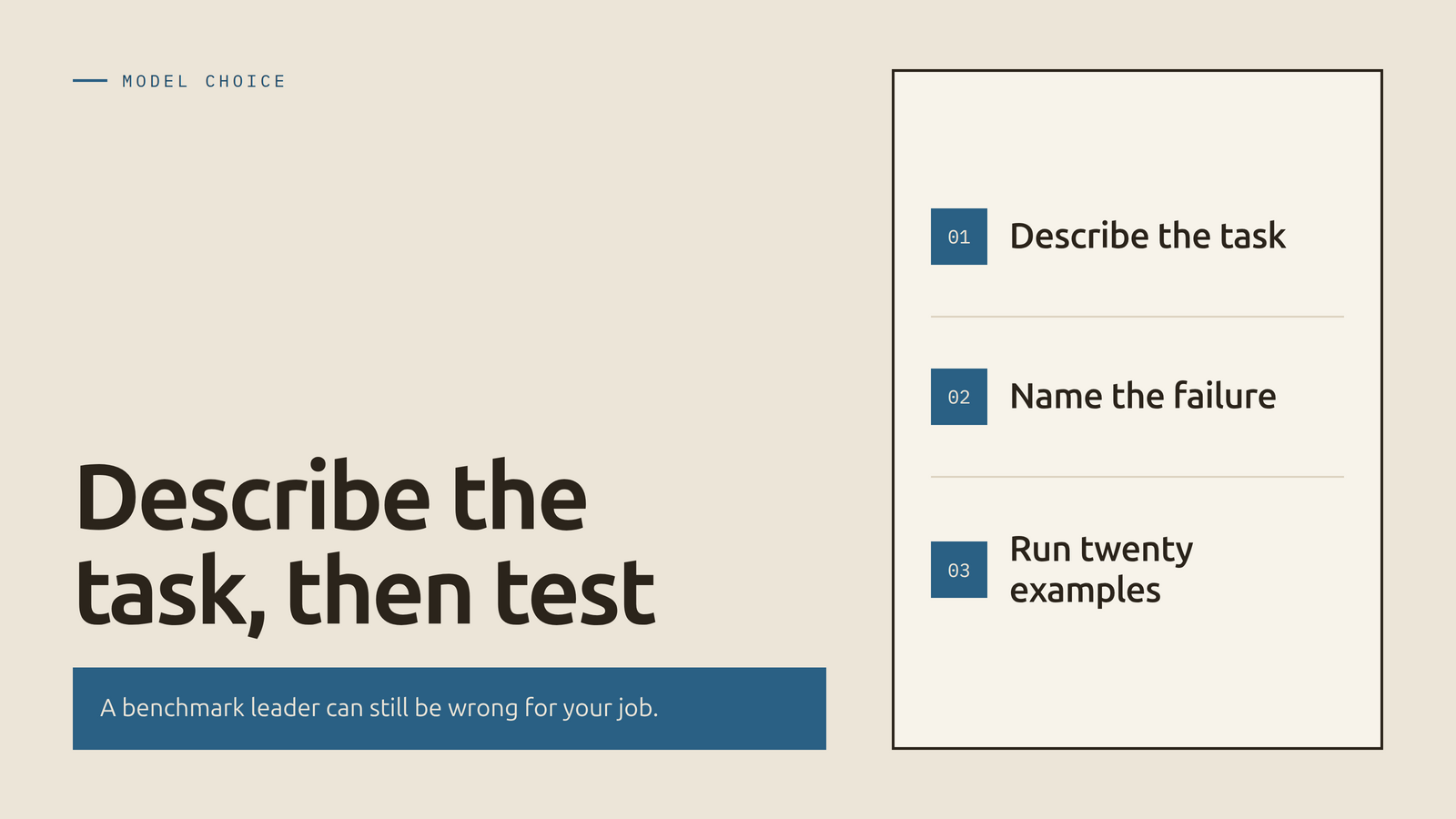
Leaderboard tables are useful for orientation and misleading for decisions. A model that tops a general benchmark can still be the wrong tool for your task, because benchmarks measure a narrow kind of question under controlled conditions. Your work has its own inputs, its own tolerance for being wrong, and its own budget.
Choosing well starts by describing the job before you compare products.
Write down what the task actually is
Summarising a long document, extracting structured fields from an email, drafting a first version of ad copy and answering a customer question are four different jobs. Each has a different failure mode, and the failure mode is what you are really shopping for.
A summariser that drops a number is dangerous, because the reader has no way to know something is missing. An extractor that invents a field is worse than one that returns nothing, because a blank is visible and an invention is not. A drafter that sounds slightly off is cheap to fix by hand.
So name the failure you can tolerate and the failure you cannot. That single sentence usually eliminates half the field before you run anything.
Match the axis to the job
Models differ on a handful of dimensions, and most tasks only care about two of them.
- Context window, for tasks where the input is long.
- Structured output reliability, for anything that feeds another program.
- Latency, for anything a person is waiting on.
- Price per token, for anything running at volume.
- Terms and licensing, for anything you redistribute or resell.
Long documents reward large context windows, but a large window does not guarantee the model uses the middle of it well. Attention thins out over very long inputs, so test with your longest real file rather than a short sample. A model that handles 200 pages in theory may lose the detail on page 90 in practice.
For structured output, check whether the model can hold a schema across many rows and whether the provider offers a constrained or JSON mode. A slightly weaker model that reliably returns valid fields beats a stronger one that needs constant repair, because the repair is where your time actually goes.
Cost is the whole loop, not the token price
A model that is ten times more expensive is only justified when the extra quality removes a review step you would otherwise pay a person to do.
Measure the loop rather than the call: the prompt you have to write, the model call, the cleanup, and the human check. A cheap model with a careful prompt often wins once cleanup is counted, and an expensive model with inconsistent formatting often loses. The per-token number is the least informative part of the comparison, because it is the only one quoted on the pricing page.
Run a small bake-off on real examples
Twenty real examples from your own work is enough to separate models. Score them against your own definition of done, not against each other, because a ranking tells you which is better at a task you may not have.
Keep edge cases in the set: an empty input, a very long input, a request that should be refused, and one example where the right answer is "I cannot tell from this". Record which model failed and how it failed.
This is more work than reading a leaderboard and far less work than shipping the wrong model and discovering it three months later, which tends to happen at the point where everything downstream depends on it. If you are also using a model to write in your own voice, the eval set doubles as the material for the style work in keeping an assistant in your brand voice.
Design for replacement
Prompts leak vendor assumptions. Keep the task description separate from the model name, so the same instruction can be pointed at a new model without a rewrite. Store the model as configuration rather than inside the prompt text.
When a new model arrives, rerun the same twenty examples and switch only if the scores justify it. Model choice is a maintenance decision, not a one-time purchase, and the eval set is what makes it cheap.
Keep two models, not one
The practical setup for most small operations is a workhorse and an escalation. The workhorse handles volume: bulk drafting, classification, extraction, anything cheap and repetitive. The escalation handles the small number of jobs where being wrong is expensive, or where the input is genuinely hard.
That split is usually cheaper than running everything on the strong model, and more reliable than running everything on the weak one. It also makes the eval set do double duty, since you learn which categories of task actually need the escalation. Wire the choice into the rest of your pipeline rather than deciding it per call, which is the same principle as automating one step at a time. When those calls are fetching your numbers, the discipline in automate affiliate reports applies to the prompt as much as to the query.
Once the model is chosen, the machine that runs it is a separate purchase: the hardware ranked by owner reviews and the 128GB unified-memory options cover that decision.