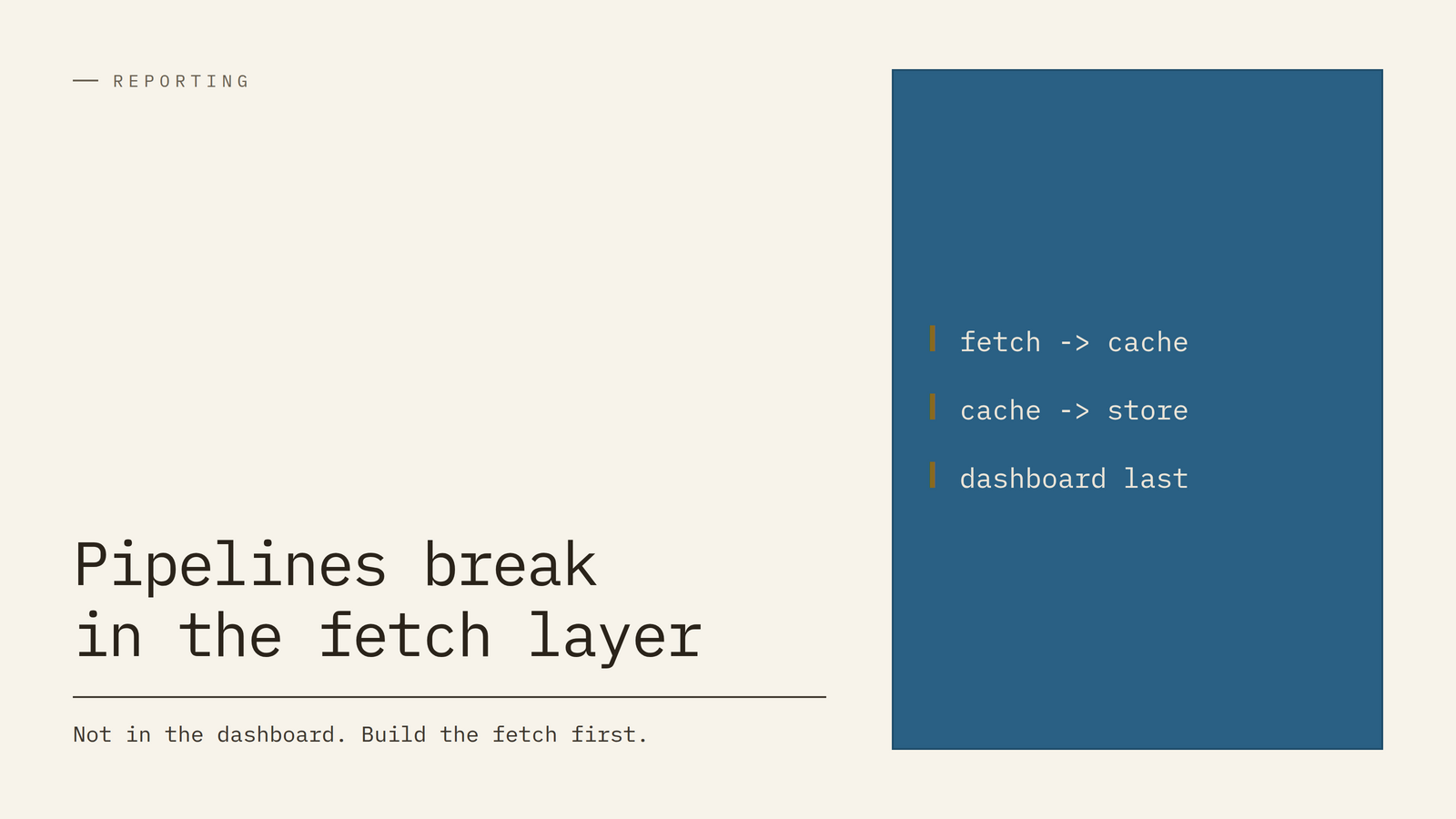
Most affiliate reporting pipelines break in the same place. Not the dashboard, and not the chart library. The layer underneath, where the numbers arrive.
Build that layer in the wrong order and you will spend the next year patching it. This is the order that survives contact with a real affiliate business.
Fetch first, format second
Start by fetching raw data from every source: trackers, ad platform APIs, internal reporting tables, the network's own transaction feed. Fetch it, store what you got, and only then decide what it means.
The query stage has to be repeatable and tolerant of upstream hiccups. Point your pipeline at the source, never at a dashboard somebody maintains by hand. If you scrape a report that a person keeps tidy, you inherit every silent failure they have. A sheet gets unpublished, a column gets renamed, an API starts throttling, and your numbers quietly go to zero instead of going red.
Only once raw data lands somewhere stable should you add a transformation layer. If you format before you fetch, you will be rewriting field mappings every time an upstream query fails.
Know what you are actually fetching
Awin's publisher API is a good example of why the fetch layer deserves respect. Its transactions endpoint takes a start date and an end date, and the largest range it will accept is 31 days. A year of history is twelve calls, not one.
The same endpoint asks you to pick a dateType: transaction, validation or amendment. That is the network telling you something important inside its own schema.
A transaction is a conversion that happened. Validation is the network deciding, later, whether you keep the money. An amendment is a correction to something you were already told.
Pull only transactions and you are reporting money that has not been approved yet. The reversals arrive months later and your revenue chart looks like it lied. It did not lie. It answered a different question than the one you asked it.
Transaction status matters for the same reason. The endpoint can return rows that are pending, approved, declined or deleted. A pipeline that counts all four as revenue is not a reporting pipeline. It is a wish.
Amazon sits at the other end of the spectrum. The Product Advertising API 5.0 has been deprecated in favour of the Creators API, and integrations still calling the old endpoint now get an HTTP 403 back. Anything you built in 2024 may be failing today while still reporting success.
Normalise before you visualise
Only after raw data lands stable should you add a transform. Map every source into a single schema. In practice that means converting time zones, normalising currency, and flattening nested JSON into rows.
Two of those deserve a warning.
Networks report in their own timezone. Awin's transactions endpoint defaults to UTC and lets you ask for another. If your store reports in local time and your network reports in UTC, the last few hours of every day sit in a different day on each side, and the two systems will never reconcile to the penny. Pick one zone, write it down, and convert at the edge.
Currency is the same problem with more decimal places. A network paying in pounds, an ad platform billing in dollars and a spreadsheet with a hardcoded rate is three versions of the truth. Store the original amount and its currency. Convert for display only.
Alert on anomalies third
Schedule the fetch and format cycle to run daily. Then add the part most people skip: something that tells you when it breaks.
Two alerts cover most of it. The job failed, or the job produced an implausible number. The second one saves you.
A total of zero counts as a failure even though the script exited cleanly, and so does a day that triples yesterday's revenue. Both have obvious causes and both stay invisible unless you test for them.
A report that runs every Tuesday and never tells you it broke is a liability, not a tool.
Reconcile against the network
A report you cannot check is a report you cannot trust, so build the check in.
Every network gives you a total somewhere. A dashboard, a monthly statement, an approved commission figure. Pull that number and compare it to yours on the same date range, in the same timezone, counting the same statuses.
When the two disagree, the disagreement is the useful part. It is almost always a timezone boundary, a status filter, or a conversion that landed after your last fetch.
Run it monthly. It takes ten minutes, and it is the only thing standing between you and a pipeline that has been quietly wrong since March. If you are still working out which statuses you should be counting, that is the same ground covered in attribution basics.
The failures worth designing for
None of these are hypothetical. They are the ones that have happened:
- A sheet shared by link gets unpublished, and the fetch returns an empty result instead of an error.
- An API key expires silently, and the endpoint answers 200 with no rows.
- A timezone or currency assumption changes under you after someone joins the team.
- A network starts returning validation rows for the first time.
- The scheduled job runs late, so it fetches a partial day and calls it final.
Every item on that list produces a plausible number rather than a crash, which is exactly why an alert on the shape of the data beats an alert on the exit code.
Earn the automation
A handful of dependable automations beats a grand system that half-works. Start with one workflow. Run it by hand, in parallel with whatever you do today, for a week. Compare its output against the number you would have reported anyway.
If they match, schedule it and start the next one. If they do not, you just found a bug for the price of a week, which is far cheaper than finding it after three more stages were built on top of it. The same discipline applies to any recurring job you are tempted to automate, including scheduling social posts with a script.
If you are not sure which workflow to start with, pick the one you already do by hand every week, which is the rule in start with one manual workflow.
The bottom line
The pipeline is not the point. Knowing which pages, placements and offers earn, early enough to do something about it, is the point. Fetch cleanly, transform once, count only approved money, and make the job complain when it fails.
That is a Saturday's work. It will outlast three dashboards.
Obligatory VPN mention: Every marketing newsletter pitches one eventually. We put ours in a dedicated piece so you can skip it on your own schedule. It is actually useful for affiliate work →