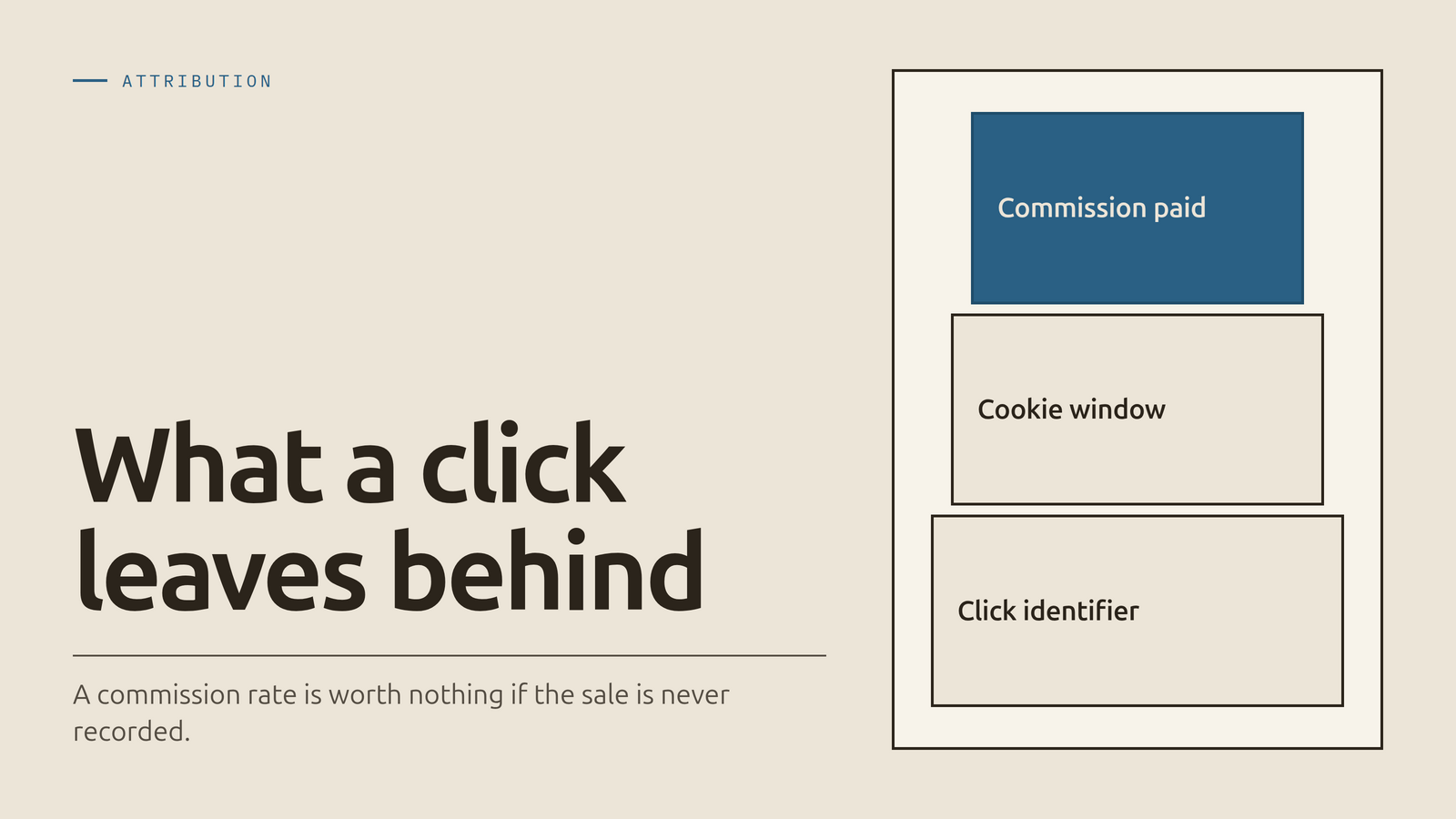
Affiliate income runs on a chain of handoffs. A reader clicks your link, something is stored, a purchase happens somewhere else, and a network decides whether you get paid. Most beginner guides skip straight to commission rates. The rate is the least interesting number in the deal, because a high rate on tracking that never records your sales is worth nothing.
Here is what is actually happening in that chain, and the questions that tell you whether a program will pay you.
What a click leaves behind
Cookie-based tracking is the default and the most fragile. A cookie gets written to the reader's browser, tied to your publisher ID and often to a click reference. Server-to-server tracking is sturdier, because the merchant tells the network about the conversion directly rather than relying on the browser to volunteer it. It also depends on the merchant implementing it properly, which not all of them do.
Ask which method a program uses, and whether both are available. If it is cookies only, you need to understand how long they last and whether there is any fallback for conversions that arrive late.
The first thing to internalise is that attribution lives in one browser. A reader who clicks on their phone and buys on a laptop is, from the network's point of view, two different people. Nothing on your end changes that.
The window is usually shorter than the marketing page says
Directory listings often quote a 30-day window for the big networks, with CJ Affiliate and Impact.com commonly listed around 45 days. Treat those as defaults, not promises. Merchant-level terms override them, and some programs run 24-hour windows while others stretch much longer.
The bigger problem is that your configured window is an upper bound the browser is free to ignore. Safari's Intelligent Tracking Prevention caps script-written cookies at seven days and clears local storage after a week without interaction. Firefox applies comparable limits in its strict mode. So a 90-day window is genuinely 90 days in Chrome and roughly a week on an iPhone, and a large share of consumer traffic is on an iPhone.
One detail helps: the window is refreshed rather than fixed. Each time a returning visitor with stored attribution loads one of your pages, the expiry gets written forward. A reader who comes back every week never ages out, even on a short window. That is a real argument for building a returning audience instead of chasing one-off search traffic.
The model decides whether your content gets paid
Now the part that catches content sites. A 30-day window sounds generous until you learn that only the last click counts.
Last-click attribution credits the most recent valid affiliate click before the purchase. It is the default on most retail programs because it is simple to explain and it favours whoever closes. Coupon sites, deal pages and loyalty publishers do very well under it.
First-click attribution credits the earliest valid click inside the window, which favours the review, the comparison and the guide. Some programs use a hybrid.
Neither model is wrong. But if you run a content site and the program you are joining is last-click only, your job is to be the last click. That is a different editorial plan than being the first one, and it is much cheaper to know which game you are playing before you write fifty articles.
Validation is a second, later gate
A conversion appearing in your report is not the same as money you have earned. Returns, cancellations, fraud checks and duplicate orders all resolve later, and reversals can arrive months after you counted the revenue. Some networks let your balance go negative because of them.
Awin's publisher API makes this distinction explicit, which is useful. Their transactions endpoint asks you to pick a dateType: transaction, validation or amendment.
A transaction is a conversion that happened. A validation is the network deciding, later, whether you keep the money. An amendment is a correction to something you were already told. The endpoint can also filter by status, which can be pending, approved, declined or deleted.
Read that as the network telling you something in its own schema. If your reporting counts every returned row as revenue, you are not measuring income. You are measuring optimism. The practical version of this is covered in how to automate affiliate reports, where counting approved rows only is the difference between a report and a wish.
Sub-IDs are how you get your own answer
Check the reporting before you commit. Can you see clicks, conversions and revenue by link, and by sub-identifier? Can you export it? A network that shows you a monthly total cannot tell you which page earns.
Sub-IDs (sometimes called tracking parameters, sub-IDs or click references) let you tag a link per placement, so the network's report and your own analytics line up. Tag by page, by position on the page, and by the specific call to action. If you run more than one placement for the same offer, distinct references are the only way to learn which one converts, and that is the same discipline as changing one variable at a time.
Test the link before you write a word
Click it yourself. Confirm the destination matches the offer you expected. Check the tracking parameter survives the redirect chain, because some networks rewrite or drop parameters along the way.
Then check what the link does on a phone, in a private window, and with an ad blocker on. You will learn more from ten minutes of that than from any review of the program.
The questions that disqualify a program
Ask these plainly, before you build a content plan.
- Which tracking method, and is there a server-side option?
- What is the window, and does it refresh?
- First click, last click or hybrid?
- What is the validation period?
- Can I report by sub-ID and export it?
- What happens to my balance when a sale is reversed?
A program that cannot answer those is telling you something. The ones that can will usually answer in a paragraph, because they already know their own terms. Take the modest rate with clean tracking over the generous rate that never records a sale.
Attribution is not a detail you fix later, it is the product you are actually choosing. When you are eventually ready to sell the site this all sits on, it is also the first thing a buyer will audit, as covered in selling an affiliate site.