A writing assistant is only useful if its output sounds like the publication it represents. Left alone it produces a smooth, generic voice that reads exactly like every other smooth, generic page on the internet. The problem is not quality in the abstract. The problem is that a reader who has read three of your articles can tell, and once they can tell, the writing stops being yours.
Getting something recognisably yours is less about a clever prompt than about constraints and examples. Here is what actually moves the output.
Write the guide a new writer could use
List the rules you would give a person on their first day. Preferred person and tense. How you handle jargon. Whether you use contractions.
How you open a piece and how you close it. What you never want to see on the page.
Keep it to one page. This is not an aesthetic preference. A one-page guide that gets pasted into the prompt every time beats a twenty-page document that nobody loads. If the guide is too long to include, it is too long to be enforced, and an unenforced style guide is decoration.
Be concrete enough to be checkable. "Write clearly" is not a rule, because nothing can fail it. "Never open with a question" is a rule, because you can look at the draft and see whether it was broken.
Show, do not describe
Two or three paragraphs you are proud of will do more than a page of adjectives about your tone, because the model can copy rhythm and structure rather than guess at them. Adjectives describe a category. Examples are the thing itself.
The most effective format is a pair: the generic version and your version, side by side. Take a paragraph the assistant would produce unaided, then rewrite it the way you would have written it. Do that five times and you have taught the pattern far better than any description of it.
Mark clearly which parts of the prompt are examples and which are instructions. Without that boundary, models tend to continue the example rather than follow the brief, and you get a fourth paragraph of your own article back instead of a new one.
The negative list earns its keep
Most style guides list what to do. The list that changes behaviour fastest is the one of things that must never appear.
Generic assistant prose has a signature. These are the tells a reader notices first:
- Em dashes used as a punctuation tic.
- Filler transitions at the start of a sentence: "furthermore", "moreover", "additionally".
- Adjectives that mean nothing on their own: "seamless", "robust", "cutting-edge", "groundbreaking".
- Openers about "the landscape of" an industry, or the fast-paced world we operate in.
- Verbs like "leverage" and "elevate".
Ban them by name. Not because each one is fatal, but because they are the tells a reader notices first, and because a specific ban is something you can grep for. A written list of forbidden strings is a rule you can check mechanically, which means it can be enforced on every draft rather than remembered when someone happens to notice.
Feed it your own copy, not a description of your copy
The strongest constraint available is your own published work. Paste in three or four finished articles, properly formatted, and tell the model they are reference material rather than content to continue.
This works better than any summary because it carries information you would not think to write down. Sentence length distribution. How often you use a one-line paragraph for emphasis. Whether you explain a term or assume it. That rhythm is the actual voice, and it is easier to imitate from examples than to reconstruct from a description.
If your assistant is generating a lot of drafts, this is also the argument for retrieving the reference material rather than pasting it manually. The mechanics of that are covered in picking a model by task, and the volume question matters once you are producing more than a couple of pieces a week.
Separate drafting from deciding
Let the assistant produce a first pass. Then review it yourself, or run a second pass that checks only for the rules the first pass tends to break. One review step catches most drift.
Two passes doing the same job is wasted effort. The useful split is generative then corrective: one pass writes, one pass audits against the ban list and the style rules, and you make the editorial call afterwards.
When the same problem recurs, add a line to the style guide rather than rewriting the prompt from scratch. Prompts are ephemeral and get lost. The style guide is the artifact that survives, and it is the thing you can hand to a new person as well as a new model.
Where the assistant must not write
Facts. Prices. Quotes. Legal and compliance claims. Anything with a number in it that a reader might act on.
The assistant should shape language, not invent substance. Feed it the verified material and let it do the phrasing, and when a fact is missing it should flag the gap rather than smooth it over with confident prose. A fabricated statistic is the one failure that does real damage, because it is the one a reader can check.
Keep a fact sheet beside the style guide. It gives the model something safe to rely on and gives you a fast way to verify a draft before it reaches anyone. Voice without accuracy is just a confident mistake.
The test: could a reader tell?
Take three paragraphs, two written by you and one generated, shuffle them, and read them cold a day later. If you cannot pick out the generated one reliably, the voice is holding. If you can, the guide is missing a rule and you have just found it.
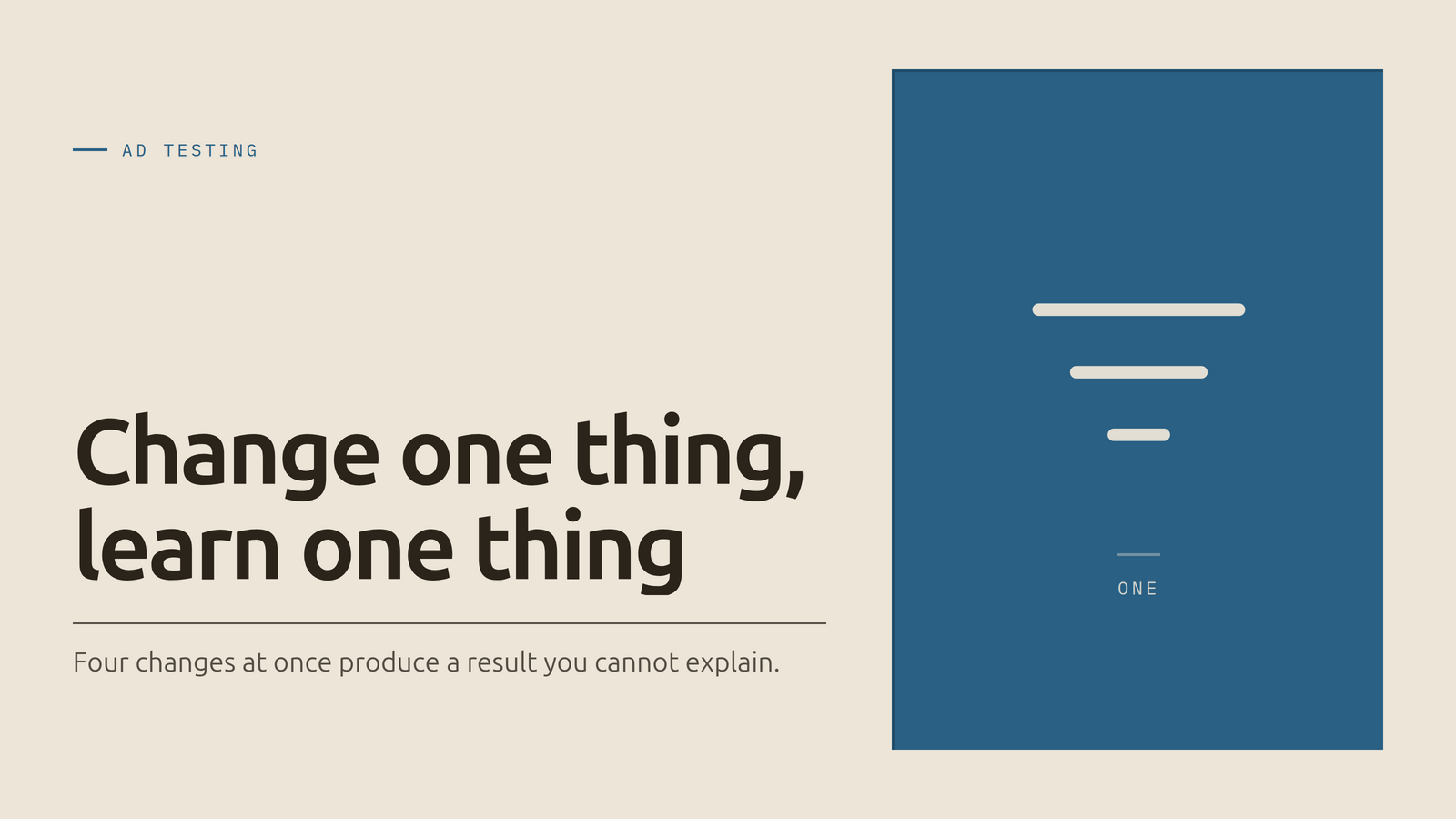
Do this periodically, because drift is gradual. Nothing fails loudly, the output just gets a little smoother every month until someone in the comments says the site reads like it was written by a machine. The same one-change-at-a-time discipline applies here as in ad testing: adjust one thing, check it, keep what worked.
A voice is worth keeping only if the substance underneath it is sound. Get the constraints right, ban the tells by name, and keep your own work in front of the model as the reference. That is most of the job, and it is a few hours rather than a project.