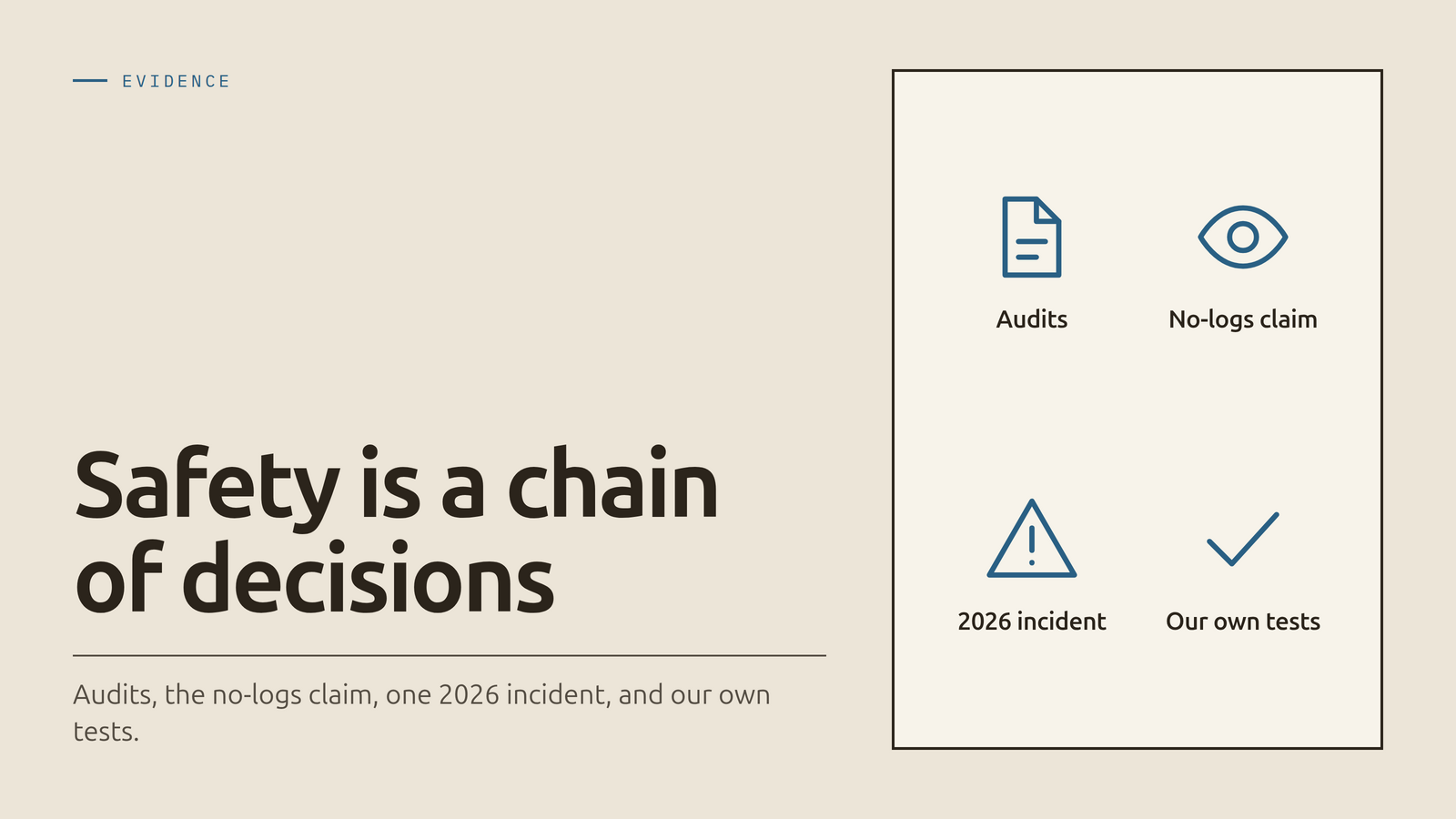
Yes — with the caveats that apply to every commercial VPN. Surfshark is a Netherlands-based provider whose no-logs policy has been examined by Deloitte, whose apps have been assessed by Cure53 and SecuRing, and whose servers run on RAM only. It is safe for what people actually buy a VPN for: keeping traffic off public Wi-Fi, stopping your ISP reading your DNS lookups, and making casual tracking by IP address harder.
It is not an anonymity layer, and no VPN is. Surfshark still sees which server you connect to and when, Dutch law can still compel it, and its apps are still software. The useful question is whether it is safe enough for what you are about to do — a different answer per use case.
4.5 / 5
A well-audited VPN with unusually broad device coverage and a transparent disclosure history, held back by the ordinary limits of commercial VPNs and by a Linux client with no command-line interface for servers and CI.
What makes a VPN safe in the first place
Four things, and the weakest one sets the ceiling. Encryption in transit means the café router, hotel Wi-Fi and ISP see ciphertext; WireGuard, OpenVPN and IKEv2 all do this well, so it is not where VPNs fail. A logging policy that is true is the real question, because "no logs" is a claim until someone independent checks it. Servers that forget matter even for an honest provider, since disk forensics can recover what a company never meant to keep. Failure behaviour decides whether a dropped tunnel is an inconvenience or a leak.
The rest is Surfshark measured against those four tests, plus who owns it and what went wrong.
How Surfshark protects your data
No-logs, audited. Surfshark says it does not record browsing history, connection timestamps, IP addresses or bandwidth. Deloitte has audited that claim, most recently in a report published in June 2025. An audited no-logs policy is worth materially more than a paragraph on a marketing page, and it is the single most important claim a VPN makes.
RAM-only servers. The whole fleet — more than 4,500 servers in 100 countries — runs without disks, so nothing survives a reboot and there is no stored copy of your session for anyone to seize later. That is an architectural difference from providers still running disk-based machines.
Encryption. AES-256-GCM, the standard used for classified material in several governments' guidance. In October 2026 Surfshark completed post-quantum authentication for WireGuard, adding ML-DSA certificates to the ML-KEM key exchange it shipped earlier, so a future quantum computer cannot impersonate a server and take over the session. At the time of writing that upgrade is live on iOS, macOS and Windows — not Linux.
Protocols. WireGuard by default: fewer lines of code than OpenVPN, faster handshakes, better battery life. OpenVPN and IKEv2 remain for networks that block it, and obfuscated servers exist for networks that detect VPN traffic at all.
The features that matter in daily use
Kill switch cuts your internet if the tunnel drops, which is the difference between a dropped connection and a silent leak. CleanWeb blocks ads, trackers and known malicious domains at DNS level, across every app, including the ones a browser extension cannot reach. MultiHop routes through two countries with separately chosen entry and exit; it roughly doubles latency and is worth it only when the threat model justifies it. Rotating IP changes your exit address periodically to frustrate long-window IP profiling, and split tunnelling lets chosen apps bypass the tunnel — useful for banking apps, a foot-gun if you forget what you excluded.
Who audits Surfshark, and who owns it
Surfshark B.V. is registered in Amsterdam (KvK 81967985). Cure53 ran the first independent audit in 2018; SecuRing has assessed infrastructure and apps since, the Android app holds a MASA certification, and Deloitte examines the no-logs claim. The company publishes an annual impact report naming the firms involved — more disclosure than most of the industry offers.
In February 2022 Surfshark merged with Nord Security, the company behind NordVPN, under a shared holding group. The brands run separate infrastructure and product teams, but the ownership is worth knowing, because a VPN's independence is part of what you are trusting.
What we measured ourselves
Most reviews quote a speed penalty borrowed from a lab on a different connection. We ran our own on a ~135 Mbit/s home cable line, using Surfshark's Linux client 3.14.0 over WireGuard and Cloudflare's speed endpoint as the target.
| Run | Download | Latency to Cloudflare | Latency to GitHub |
|---|---|---|---|
| Direct, no VPN | 135.3 Mbit/s | 30.2 ms | 50.0 ms |
| Surfshark, US server, run 1 | 137.0 Mbit/s | 40.2 ms | 66.6 ms |
| Surfshark, US server, run 2 | 137.8 Mbit/s | 35.0 ms | 64.2 ms |
| Surfshark, US server, run 3 | 126.4 Mbit/s | 36.0 ms | 65.8 ms |
Read honestly, that says less than "Surfshark is fast". Throughput did not measurably move: every tunnel run landed inside the spread of the direct run's own three samples, on a line too slow for the VPN to be the bottleneck. Latency rose consistently, by 6–10 ms to Cloudflare and 14–16 ms to GitHub, and DNS lookups stayed inside the tunnel. Upload was too variable to quote, and our line has no IPv6 at all, so we make no claim about IPv6 leak behaviour — that test needs a connection that can prove it. The honest expectation on a line this size is no noticeable throughput change and a few extra milliseconds.
The September 2026 incident
On 2 September 2026 Surfshark confirmed that an internal test server had been left reachable from the internet by human error and accessed by an unauthorised party. It contained the issue the same day, finished remediation by 5 September, rotated every secret it could identify, and published an incident report on 8 September.
Reached: parts of system binaries and internal configuration, some build-related credentials that had at times been committed to code history, and an isolated content-optimisation proxy. Surfshark says user data, VPN traffic, account identities, IP addresses and encryption keys were not involved, and that access logs showed no malicious use.
Two things are true at once. A server that should not have been on the internet was, and credentials ended up in a repository — a real engineering failure, and any review omitting it is not a review. But the failure sat in an internal environment separated from production, it did not involve customer data, and the company disclosed it within a week instead of being caught months later. "No incident" at a competitor usually means "no disclosure".
Common concerns, answered plainly
Jurisdiction. The Netherlands is a Nine Eyes country, so Dutch law can compel a company to hand over what it holds. The defence is not the jurisdiction but the fact that an audited no-logs provider holds almost nothing, and RAM-only servers forget on reboot.
What is collected anyway? An email address, payment details handled by the processor, and what keeps an account working. Whether connection metadata is retained is the claim worth checking — Surfshark's audited position is that it is not.
Can it be hacked? Not by breaking AES-256. The plausible paths are a stolen credential, a misconfigured internal system, a supply-chain problem in a build, or a client vulnerability. Surfshark hit the second in 2026 and contained it in a day. Keep the app updated, and read any provider's incident history as the best evidence of how it behaves next time.
Where a VPN stops helping
- It is not anonymity. Logged into Google or Meta, you are identified whatever your exit IP. A VPN changes your network address, not your cookies, fingerprint or behaviour.
- It does not stop malware or phishing, and it cannot make a compromised device trustworthy.
- It cannot defeat account-level tracking, where the most valuable signals come from logins and pixels the VPN never sees.
- Some services block it. A blocked checkout is detection working as designed, not a security failure.
- Your own configuration can undo it — split tunnelling excluding the wrong app, or a browser proxied outside the tunnel, produces false confidence.
Is it safe for what you are doing?
Public Wi-Fi, hotels, airports: yes, and this is where the value is least arguable — the kill switch and DNS handling do the work. Stopping ISP profiling at home: yes; your ISP sees a tunnel and a server address. Reducing IP-based tracking: yes, with the caveat that logins and fingerprinting dominate. Servers, CI and headless machines: the weakest ground, and a client limitation rather than a security one — there is no command-line client, so you follow Surfshark's manual WireGuard setup and manage the tunnel yourself. It works and it is documented; it is just more manual than a dedicated CLI. Anonymity from a state-level adversary: no commercial VPN is the right tool, including this one.
What works
- No-logs policy audited by Deloitte, with Cure53 and SecuRing assessments behind the apps
- Entire fleet RAM-only, so nothing persists across a reboot
- WireGuard by default, with post-quantum authentication shipped in October 2026
- Unlimited simultaneous devices on one subscription
- Kill switch, CleanWeb, MultiHop and split tunnelling included rather than tiered away
- Prompt, specific disclosure of the September 2026 incident
Where it falls short
- No command-line client, so headless and CI use means manual WireGuard setup
- Dutch jurisdiction and shared ownership with Nord Security
- Post-quantum WireGuard not yet available on Linux
- Renewal pricing far above the promotional first term
- Dedicated IP is a separate, non-refundable purchase, one per account
- A 2026 internal-environment exposure shows engineering-side risk is real
What it costs, and what the price hides
Prices checked 22 October 2026.
| Plan | Includes | Promotional price | Renewal |
|---|---|---|---|
| Starter | VPN, Alternative ID | $2.49/mo — $67.23 for 27 months | ≈ $18.95/mo |
| One | Adds Alert, Search, Antivirus | $2.49/mo — $67.23 for 27 months | ≈ $19.95/mo |
| One+ | Adds Incogni data removal | $3.99/mo — $107.73 for 27 months | ≈ $22.85/mo |
The headline figure is for a long term paid up front, and it is a promotion — the date above matters and it will have moved by the time you read this. The renewal column is derived from the pre-discount totals on the same page and lands near eight times the promotional rate. For one trip, the 30-day money-back window is worth more than the multi-year discount, and the 7-day trial in the mobile app stores is the cheapest way to see how the client behaves on your devices.
Dedicated IP is in no bundle: separate, around $3.75 a month, one per account, non-refundable. The honest reason to want one is escaping CAPTCHA loops and blocklists when you need a stable address — it makes you more identifiable, not less.
Verdict
Surfshark is safe the way a well-run commercial VPN can be: an audited no-logs policy, RAM-only servers, strong standard encryption, a working kill switch, and a company that discloses its failures. The reasons to hesitate are equally concrete — Dutch jurisdiction, shared ownership with Nord Security, no Linux command-line client, and a renewal price several times the advertised one. For public Wi-Fi and keeping your ISP out of your lookups it is a reasonable choice, cheap per device thanks to the device limit. For anonymity from a serious adversary, or a fleet of headless machines, read the limitations before the features. Safety is not a badge earned once; it is the decisions that still hold when the tunnel drops.
See Surfshark plans — 30-day money-back window applies; prices change, so check the date above.
Frequently asked
Is Surfshark VPN really safe?
Yes, for ordinary privacy work. Its no-logs claim has been audited by Deloitte, its servers keep nothing on disk, and its apps have been independently assessed. The limits are the ones that apply to every commercial VPN: it is not anonymity, it does not stop account-level tracking, and you are trusting a Dutch company to honour a policy it has had audited.
What are the downsides of Surfshark?
The practical ones are the renewal price, several times the promotional rate; no command-line client, which makes servers and CI a manual WireGuard exercise; post-quantum WireGuard not yet on Linux; and Dutch jurisdiction with shared ownership with Nord Security.
Can Surfshark VPN be hacked?
Not by breaking its encryption, which is AES-256 and not the weak point. The plausible paths are a stolen credential, a misconfigured internal system, a supply-chain compromise in a build, or a client vulnerability. Surfshark hit the second in 2026 and contained it within a day.
Is Surfshark safe for public Wi-Fi?
It is the use case where the value is clearest: the tunnel encrypts traffic past the router, DNS lookups go through the VPN rather than the network's resolver, and the kill switch stops traffic if the connection drops. It does not protect you from a captive portal you log into voluntarily.
Check current price — promotional terms change; the promotional and renewal figures above were checked on 22 October 2026.
If the price is the part you came for, the annual breakdown is in what the plan costs over a year; if you are buying it for client logins rather than streaming, the five checks before you pay are the ones that decide it.