What Surfshark costs in 2026, and where the discount ends
The number on Surfshark's pricing page is CA$3.39 a month, and it is the least useful figure there. It is a 27-month rate, it excludes tax, and it is not what the plan renews at. Read the page as a buyer rather than as a browser and four numbers matter: what you pay today, how long that payment covers, what the plan costs after that, and how long you have to change your mind. This piece walks through all four from the page as it stood on 5 November 2026.
Prices checked against Surfshark's own pricing page on 5 November 2026, from a Canadian connection, which is why the figures are in Canadian dollars and carry the Black Friday banner that was live that day. Surfshark's page states plainly that pricing varies with currency, VAT and any coupon applied, so treat these as one reading of a page rather than a permanent price list.
The three plans, priced as they stood that day
Surfshark sells one VPN in three bundles, and on the 24-month term two of them cost the same per month:
- Starter — CA$3.39 a month, billed CA$91.53 for the first 27 months (24 months plus 3 extra). The page puts the crossed-out "old price" for the same term at CA$696.33 and labels the difference an 87% saving.
- One — CA$3.39 a month, CA$91.53 for the same 27 months, old price CA$731.43, also labelled 87%.
- One+ — CA$5.39 a month, CA$145.53 for 27 months, old price CA$839.43, labelled 83%.
Every plan on the page carried the same 30-day money-back guarantee, and the same small line underneath the total: VAT may apply. That line is not decoration. On a CA$91.53 charge, a 20% VAT bill is another CA$18, and it is charged at checkout, not on the banner you clicked.
SponsoredSurfshark's current plans and prices — the page this article was written from. It is an affiliate link; if you buy through it this site earns a commission, and the price you pay does not change.
Why the monthly figure is the least useful number on the page
CA$3.39 is arithmetic, not an offer. Divide the amount billed by the months it covers and you get it back exactly: CA$91.53 over 27 months is CA$3.39, and CA$145.53 over the same term is CA$5.39. The discount is not a price cut on the product; it is a price cut on the term. You get that rate because you paid for more than two years at once.
Two consequences follow, and both are easy to miss while reading a big number in small type.
The first is that the rate only holds if you keep the subscription for the whole term. Cancel in month six and the money you have already paid does not convert into a pro-rata refund — the 30-day window is the one you get, which is why the next section is about the refund rather than the discount.
The second is that the monthly plan is a different product at a different price. The pricing page offers 24 months, 12 months and 1 month as separate tabs, and the page's own FAQ says the monthly plan is "available at a higher rate". If you want the tool for a single project, the 27-month rate is the wrong column to be reading, however good it looks.
What 27 months costs you per year, in plain arithmetic
Surfshark does not publish an annual figure for the 24-month term, so here is the division done for you, using the page's own numbers. This is our arithmetic, not a quote from the vendor:
- CA$91.53 over 27 months is about CA$40.68 for each 12 months of cover.
- CA$145.53 over 27 months is about CA$64.68 for each 12 months of cover.
- The same terms at the crossed-out prices — CA$696.33 and CA$839.43 — work out at about CA$309 and CA$373 for each 12 months.
That last pair is the honest bracket for the whole decision. The gap between CA$41 and CA$309 a year on the same Starter plan is not a sale that runs forever; it is the difference between the introductory term and whatever the plan costs once that term ends.
What happens at renewal
The page is careful here, and the care is worth reading as a warning. Asked what the service costs after two years, its FAQ answers that the cost "depends on the chosen plan" and that "upon renewal, you will be charged the applicable renewal price". It does not promise the rate you signed up at. The crossed-out figure next to the deal — CA$696.33 for Starter — is the anchor the discount is measured against, and it is the closest thing on the page to an indication of what a renewal looks like, but it is not labelled as one.
Billing terms are stated more precisely. The monthly plan is billed every month, the 1-year plan every 12 months, and the 2-year plan once at the start and then annually once it expires. So the renewal that matters is not the one in 27 months — it is the annual charge that starts after that, at a price nobody quoted you at signup.
Before paying, open the checkout and read the renewal line. If a vendor will not show you the post-term price before you enter card details, that is the answer to a different question: whether to buy at all.
The one control that costs nothing: the 30-day refund
Every plan on the page carries a 30-day money-back guarantee. That window is the only part of this purchase you can test at no risk, and it is long enough to answer the two questions a price page cannot: does the connection hold on your own network, and does the thing you bought it for actually work.
A refund window is also a deadline, and deadlines are where buyers lose money. Put the end date in a calendar on the day you pay, not on the day you notice something is wrong. We have not run a speed test on these plans; what this article prices is the deal, not the network.
How to check the price in two minutes, wherever you are
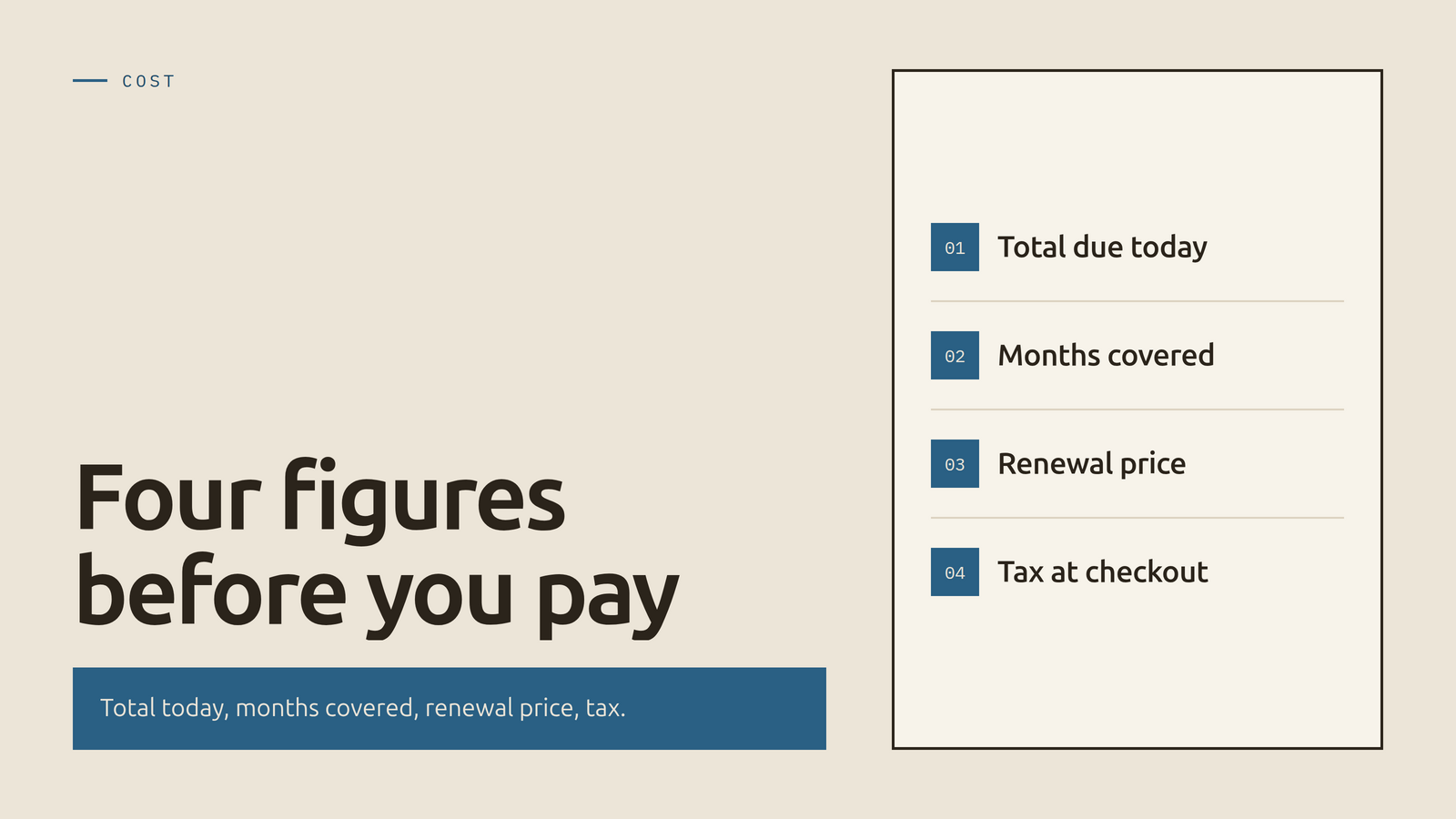
Prices on this page are regional, so the figure in your currency will differ from the one above. The check is the same four questions, and the page answers all of them if you look in the right places:
- Total due today — the amount, not the monthly rate. It is printed under the plan cards next to the term.
- What that covers — the number of months, including the extra months the deal adds. Count them; the term is longer than the headline "24 months" on the tab.
- The renewal price — in the checkout, before you pay. If it is absent, assume the crossed-out figure and decide whether you would still buy at that.
- Tax — the "VAT may apply" line, resolved into a number at checkout.
If you want the short version: a VPN subscription is a two-part price — the term you sign for and the term you renew into — and the published monthly rate describes neither of them on its own.
Questions this page gets asked
Is Surfshark cheaper monthly or on the long term?
The long term, by a wide margin, and that is the whole design of the pricing page. The 27-month term is the cheapest per-month rate Surfshark publishes; the monthly tab is the most expensive way to buy the same access. The trade is commitment: the low rate only makes sense if you expect to keep using it for two years and a quarter.
Does the price go up after the first term?
The page says renewal is charged at "the applicable renewal price" and does not fix that price at signup, so yes, expect a change. The honest planning number is the crossed-out figure beside the deal, not the CA$3.39 headline. Check the renewal line at checkout and write down the date.
Why is the price different from what I see?
Currency, tax and coupons. Surfshark's own disclaimer says pricing varies with the currency you use, VAT and applied discounts, and the page serves a local currency based on where it thinks you are. Two readers on the same day can see different totals for the same plan without either of them being shown a wrong number.
Is there a cheaper way to buy the same thing?
Not from the vendor's own page — the discounts there are term-length deals, not codes. Third-party coupon sites mostly recycle the same public offer, sometimes with an older price attached. If a code is not applied at checkout, it was not real.
If the question was never really the price — if what you need is a fixed address for client logins rather than a cheap streaming subscription — the five buying checks for affiliate work are the better place to start, and whether the provider's own claims hold up is covered separately.
Prices and terms in this article were checked on 5 November 2026 and will age. The method will not: total due, term covered, renewal price, tax, and the refund date in your calendar. If you want the same question answered for a different kind of vendor — an affiliate programme rather than a VPN — the disclosure page explains what this site earns and from whom.