An AI writing assistant does not announce that it has stopped sounding like you. The change arrives as a batch of drafts that read fine, pass a spellcheck, and feel slightly wrong in a way nobody can point at. Left alone for a month, the drift becomes the house style, and pieces in your AI writing assistant brand voice are the exception. Three signals show up first, and each has a cheap check attached.
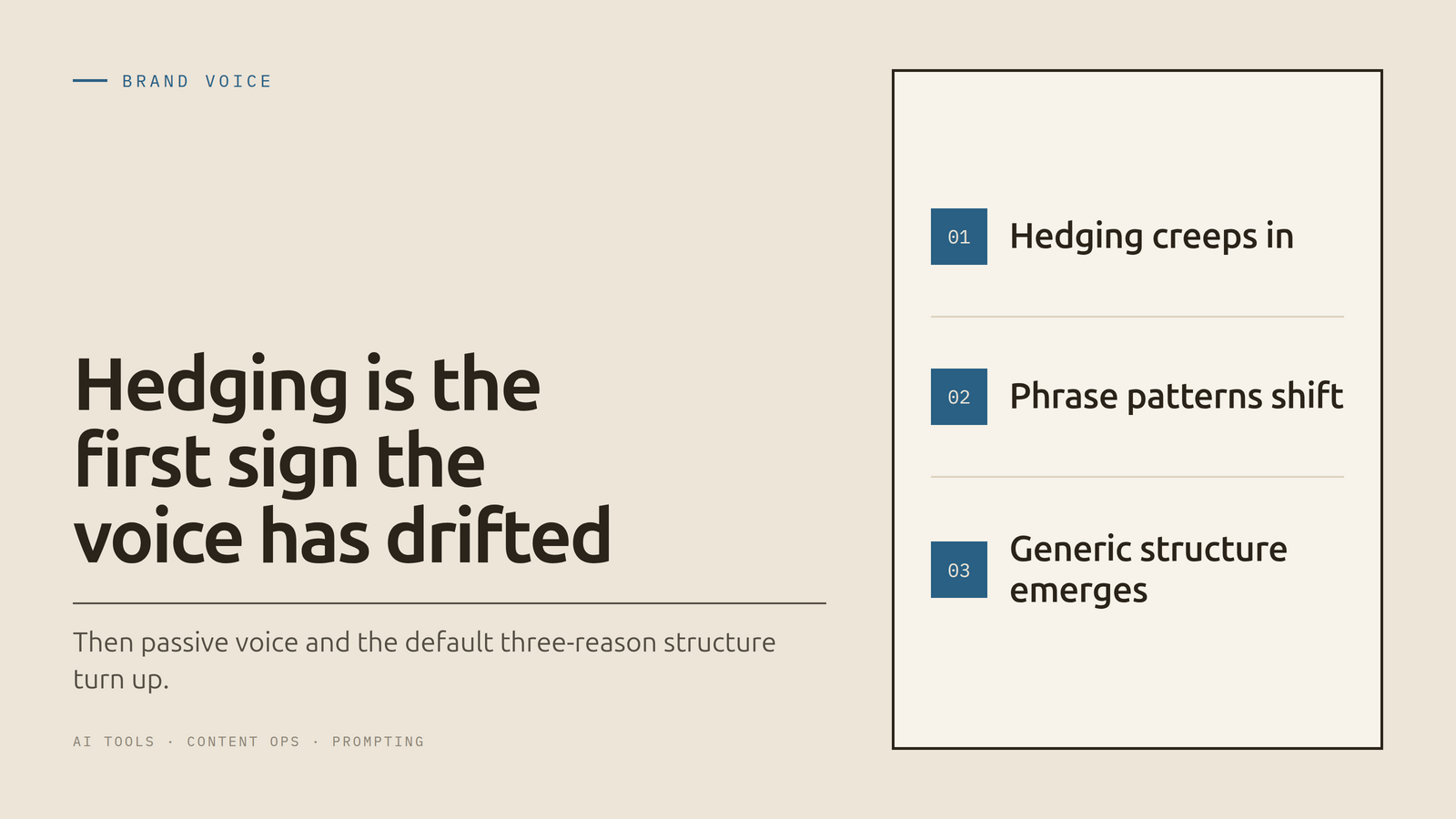
Sign one: hedging creeps into claims
Your brand says "This is the best offer." The assistant starts saying "This may be considered one of the better offers," or "Some might argue this is the best offer." Nothing there is false, and nothing sounds like you. Hedging phrases like arguably, it could be said, and in some cases are the model defaulting to cautious, generic language, because a hedge is the safest output: it cannot be wrong if it never commits.
Watch for the hedge arriving with a qualifier attached. A request for a professional tone, a balanced view, or copy that will not offend anyone all push the same direction, and so does a prompt that says "be accurate" without an example of what a committed claim looks like in your voice. The assistant reads the instruction, cannot tell which claims you stand behind, and hedges all of them.
The check is a scan, not a judgement call. Take five recent drafts, search for the hedge list, and count. One hedge can be a considered choice. A hedge in every third paragraph is drift, and it reads as a writer who does not believe their own advice. Spot it early and retrain with examples in your direct voice.
Sign two: sentences lose their rhythm
If you use short, punchy sentences and the assistant starts producing longer structures with subordinate clauses stacked inside them, your brand has drifted. If you favour the active voice and it switches to passive, the voice is gone. Rhythm is the part readers recognise before they can name it, which is why drift here feels worse than hedging even when the meaning is intact.
The tell is a sentence that needs two commas to survive. Your original says the campaign is losing money and should be paused. The drifted version says the campaign may not be performing as expected and pausing it might be worth considering. Same advice, no decision, and twice the length. The passive version hides who is doing the thing, which matters in copy meant to tell a reader what to do next.
Read a batch of outputs side by side with your style guide rather than one at a time. Mismatches show up immediately in a stack that they hide in a single draft, because the eye compares sentence length before it parses meaning. If your guide has a note on sentence length, openings, or point of view, this read shows whether the guide is being followed.
Sign three: the generic structure comes back
Most assistants default to a shape you recognise: here is the topic, here are three reasons, here is the summary. That structure is invisible until you see it across ten pieces. Your voice probably has a distinct arc: storytelling instead of lists, pattern-breaking instead of predictability, an ending that lands on an image rather than a summary of what you just said. When the assistant abandons yours, readers feel a piece that never gets going.
Structure drift is the hardest to catch because each piece looks organised. The evidence is only in the set. Lay the openings side by side: do they all start with a definition, a scene-setting clause, or a restatement of the title? Look at the closings: do they all begin with a phrase that signals a summary? Check whether the same three-item list appears in every piece, whether or not the topic wanted three items.
Your structure is a claim about how you think. A list is one way to organise an argument and a story is another; the choice is part of the brand, not a formatting preference. If every piece arrives in the same shape, the assistant has replaced your judgement with its template.
Why AI writing assistant brand voice drifts on its own
Nobody usually changes the prompt. What changes is everything around it. Prompts get edited under deadline, and each edit tends to swap a specific instruction for a general one, because the general one is quicker to write. A prompt that once said "open with the number and never use the word solution" becomes "write in a friendly, professional tone". The second version describes a voice. The first one demonstrated it.
The examples age too. Three pieces from last year may no longer represent how you write, and examples replaced by summaries of themselves teach the summary rather than the voice. There is a feedback loop worth watching: if the examples are drafts the assistant wrote, you are asking it to imitate itself, and each round moves the output closer to the average of the last.
Long sessions add another push. Earlier text in the context acts as an example whether or not you meant it to, so a chat running for hours with several generic rewrites in it produces more generic rewrites. Model changes matter for the same reason: a new version has different defaults, and a prompt tuned to the old one no longer lands where it did. None of this is a fault in the tool. It is drift, and drift is caught by checking.
The weekly check that catches drift first
One short session a week, in the same order, beats a long review after a bad month.
- Keep three published pieces that sound most like you. This is the reference set.
- Take five recent drafts the assistant produced, including ones you published.
- Read one reference piece first, so your ear is calibrated.
- Scan for the hedge list and mark every hit.
- Read each first sentence. It should carry a fact or a claim, not a warm-up.
- Mark any sentence that needs more than one comma to survive.
- Compare openings and closings across the five. If they share a shape, that is structure drift.
- Log the result next to the prompt version and model name, so a change in output traces to a change you made.
The table below shows what the check catches.
| What your voice does | What the drifted draft does | What changed |
|---|---|---|
| This is the best offer on the list. | This may be considered one of the better offers on the list. | A claim became a hedged opinion. |
| Pause the campaign. It is losing money. | It might be worth considering whether the campaign should be paused, as it may not be performing as expected. | Two short sentences became one long suggestion, and the instruction disappeared. |
| The report loads in four seconds. | Generally speaking, the report tends to load fairly quickly in most cases. | A specific fact became an average with a hedge on top. |
| Your click-through rate fell this week. | In the modern advertising world, performance is more important than ever. | A fact was replaced with a scene-setting clause that says nothing. |
Reading a drifted line next to your own is the point. The instruction "write conversationally" cannot show that a sentence lost its verb. The pair can.
Fix it with examples, not instructions
Feed the assistant three pieces you love in your actual voice, then ask it to match the tone and the structure. Prompt instructions fail on their own, because the model has to guess what "conversational" or "punchy" means, and it will guess at the average of everything it has seen. Good examples work because there is nothing left to guess: sentence length, openings, and endings are in front of it.
Keep the examples in the prompt as pasted text, not a link the model cannot open, and refresh them when your voice moves. Add the drifted lines as negative examples with the correction written out. A pair showing both directions teaches more than a page of rules.
Version the prompt and note the model beside it, so when the output changes you know whether the tool moved or your instructions did. Then read one generated piece against the reference set before it goes out, which keeps the drift visible while it is still small. If the tool keeps pushing toward the middle of the road, the argument for choosing a model by the job is in picking an AI model by task, and the workflow for keeping a voice on file is in giving an AI assistant your brand voice.
Next week, put three pieces that sound like you in one folder, run the five-draft check, and mark every hedge and every sentence that needs two commas. Fix the prompt with the pairs you found. One session costs less than a month of pieces that read like a press release.
FAQ
How often should I run the drift check?
Weekly is enough for a publishing schedule, and better than a monthly review, which is too many drafts to compare accurately. Run it sooner after anything that could shift the output: a model change, a prompt rewrite, a new contributor, or a batch you had to ship fast. Skip it and you find the drift in a published piece, where the fix is an apology.
Does a longer prompt stop brand drift?
Usually not. A longer prompt adds instructions, and instructions are the weakest tool available, because every adjective has to be interpreted. A page of rules can make drift worse by burying the three examples doing the work. Length is not the variable to optimise. What matters is whether the prompt contains text in your voice the model can copy, and whether the instructions contradict it.
Should I fix drift with rules or examples?
Both, in that order: examples first, then a short rule about what never to do. Use examples for tone, rhythm, and structure, because those are hard to describe and easy to copy. Use rules for the absolute things: a word you never use, a claim you never make, a format you never open with. If a rule and an example disagree, the model usually follows the example, so check the pairs agree first.
Some links on this site are affiliate links. The disclosure page explains how that works.