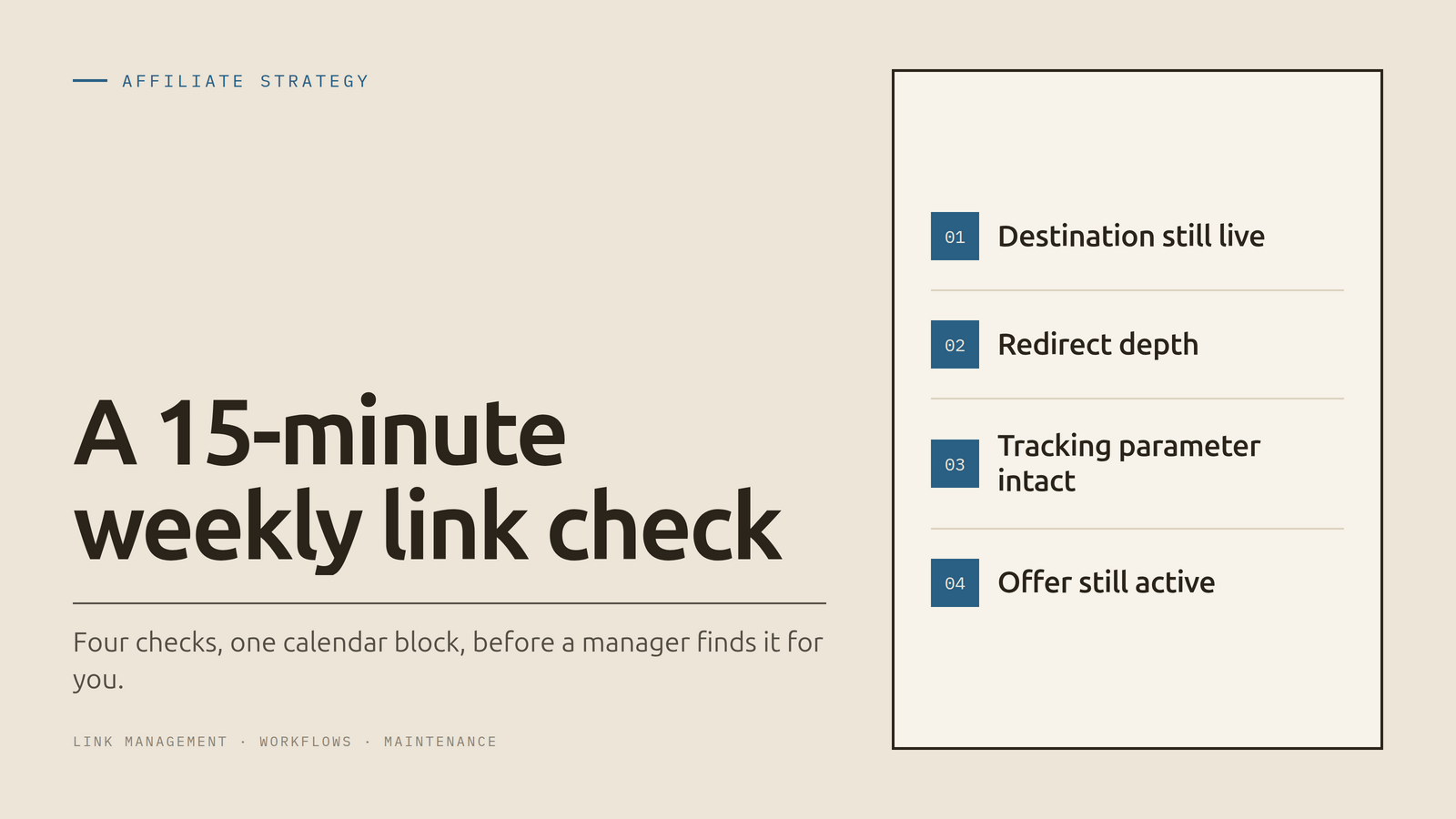
A link audit is four checks: the destination still loads, the redirect chain is short, the tracking parameter survives the trip, and the offer is still there when a reader arrives. That is the whole checklist, and none of the four takes long. What makes a link audit work is not the checklist but the calendar block that runs it, because the failures it catches are the kind you otherwise hear about from an affiliate manager, weeks late, in a message that starts with a question about last month's traffic.
The routine below fits into fifteen minutes on a Tuesday or Friday morning. It checks five links per session and rotates through your active list, so nothing sits unexamined for long.
A link audit starts with the destination
Open the article and click the link the way a reader would. Not the network's test link in the dashboard, and not a saved copy in a spreadsheet. The link inside the published page, on a phone or in a browser where you are not signed in to the merchant's site, because a signed-in session can hide a geo or consent redirect.
Confirm it lands where you expect. Three things break this. The merchant moves or retires a product page and the old URL starts rendering a category or a homepage instead of the offer. A domain lapses or a redirect target goes dead and the reader gets an error page. A redirect chain breaks partway through and lands somewhere the tracking has already been stripped.
The subtler failure is the page that loads but no longer matches the article. You wrote about a specific plan, the merchant replaced it, and the reader arrives at something your prose does not describe. They bounce, the click is recorded, you get nothing, and the article slowly loses whatever trust it had. While you are on the page, check that the product name on the screen is the product name in your paragraph.
Redirect depth tells you what changed on the merchant side
Count the hops. A browser address bar will not show them, so use a network tool or curl -sIL against the link and read the chain of Location headers. You are looking for two things: how many hops there are, and whether that number has changed since the last audit.
More than three hops is a warning sign. Long chains break more often because each hop is a dependency, and every one of them is maintained by someone else. They also load slower, which matters on a phone. If the depth has grown since last week, something changed on the merchant side, and the change is usually a platform migration, a new consent interstitial, or a geo-based redirect that now sits in front of the offer.
Learn what the normal chain looks like for each network you work with, and write the number in your notes. A chain of two that becomes a chain of five is the early warning that a merchant replatformed, and that is exactly the week to re-test tracking.
Tracking parameters have to survive the whole chain
Click the link and read the final URL bar. Your tracking parameter should still be in it after every redirect has run. If it is gone, the network will not credit the click, and no amount of traffic will fix that.
Parameters usually disappear for one of three reasons. A redirect rebuilds the query string from scratch and drops what it does not recognise. A jump page or link cloaker handles parameters with its own rules and loses the ones it was not configured for. Or a script navigates the browser to the destination instead of letting the server redirect, so nothing carries across.
Test this monthly, and test it immediately after any merchant platform change, because a migration is the moment the query-string handling gets rewritten. Do not assume the network's click ID and your sub-ID behave the same way. The click ID often gets set as a cookie on the first hop and survives, while your sub-ID lives only in the URL and dies with it. If you cannot tell which is which, how attribution is counted covers how credit gets assigned once the click lands.
The four checks and what each one catches
The table is the version to keep next to your list. Each row takes under a minute once you have done it a few times.
| Check | How to run it | What a failure looks like | How often |
|---|---|---|---|
| Destination live | Click the in-article link on a phone, not signed in | Error page, homepage instead of the offer, product gone | Every audit |
| Redirect depth | Read the Location headers with curl or a network tool | More than three hops, or depth grown since last check | Every audit |
| Tracking parameter | Compare the final URL against the link you published | Parameter missing, or the wrong value survives | Monthly, and after any platform change |
| Offer still active | Read the destination page against your article | Price changed, plan replaced, promotion ended | Every audit |
Nothing in that table needs a subscription. It needs a notebook, a link list, and the discipline to run the block when it appears in the calendar.
Put the block on the calendar and rotate the list
Pick a morning, Tuesday or Friday, and give it fifteen minutes. Audit five links. That is the entire commitment, and it is small enough to survive a busy week, which is the only property a maintenance routine really needs.
Keep the list in one place: the URL, the network, the article it sits in, the date last checked, and the status. Rotate through it in order. A monthly pass over all your active links means each link gets checked three or four times a year, which is enough to catch most problems before they cost you a month of credit.
Log the outcome in one of three states, because the states map to different actions.
- Clean: nothing changed, and the date is recorded.
- Fixed: you corrected something, so note what and when.
- Escalated: the problem sits on the merchant or network side and you have a message out about it.
That escalation list is the thing you review first next session, and it is also the evidence you need if a commission later goes missing.
Two habits make the block shorter over time. Fix links in your content, not just in the spreadsheet, and write the date in a comment or a note so future you knows when the URL last changed. And treat a silent week as a result, not a non-event: a clean audit is the confirmation that the rest of your time can go into writing. If you want the audit to feed something bigger, the same item-and-status pattern is what starting automation from one manual workflow is built on.
Keep the list honest in one more way. When you retire an article or stop promoting a programme, delete the row instead of leaving it to fail quietly in the rotation. A list that only grows stops being a checklist and becomes a backlog, and the fifteen minutes get spent re-checking dead links instead of the ones still earning. Five links an audit is the budget, and the only way to keep it is to remove what no longer belongs.
FAQ
How often should I run a link audit?
Weekly is the right rhythm for the whole list, with five links per session and a rotation that brings each link round three or four times a year. Tracking parameters deserve a separate monthly pass because they break during platform changes rather than gradually. The point of the weekly block is that it is small: fifteen minutes is survivable in a bad week, and a routine you actually run beats a thorough one you postpone until something breaks.
What counts as a broken redirect chain?
A chain that never reaches the destination, or reaches it without your parameters, is broken. A chain that still arrives but has more than three hops is fragile and worth investigating before it fails. Compare the depth against the last audit rather than against a fixed rule of thumb. Growth is the signal that a merchant changed something upstream, and those are the weeks when tracking tends to go missing too.
The tracking parameter is missing but the link still works. Is that a problem?
Yes, and it is the more expensive kind of problem because nothing looks broken. The reader arrives at the offer, the page renders, and the click earns nothing because the network never saw an identifier it could credit. Treat a missing parameter as a broken link and fix it before you send any more traffic. Then check whether the loss came from the merchant's redirect or from your own jump page, since only one of those is yours to fix permanently.
Next week, export your active links into one list, add the status column, and book the fifteen-minute block for a morning you will not skip. Run five links, log the results, and let the rotation do the rest.
Some links on this site are affiliate links. The disclosure page explains how that works.