Signing up takes minutes, and most of the problems that follow are decided in those minutes. The rate on the offer page is the least informative number there: it says nothing about whether your sales get recorded, how long the network holds the money, or whether you can see which link earned it. To vet an affiliate programme properly, treat sign-up as a procurement decision. Ask what you would ask a supplier who handles your invoices, and get the answers in writing, because the person on the call is rarely the system that processes the conversion.
Start with how the programme records a sale
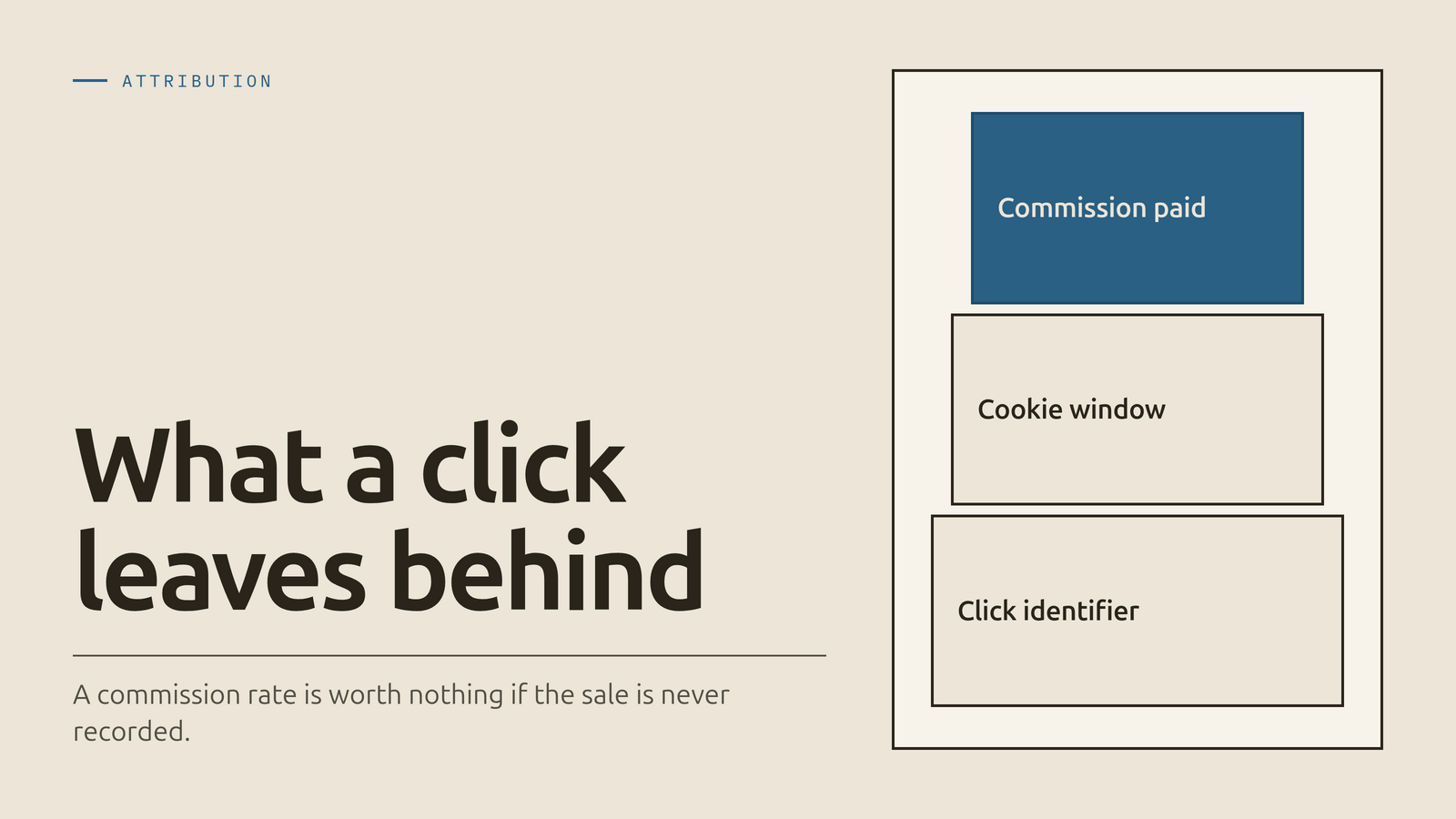
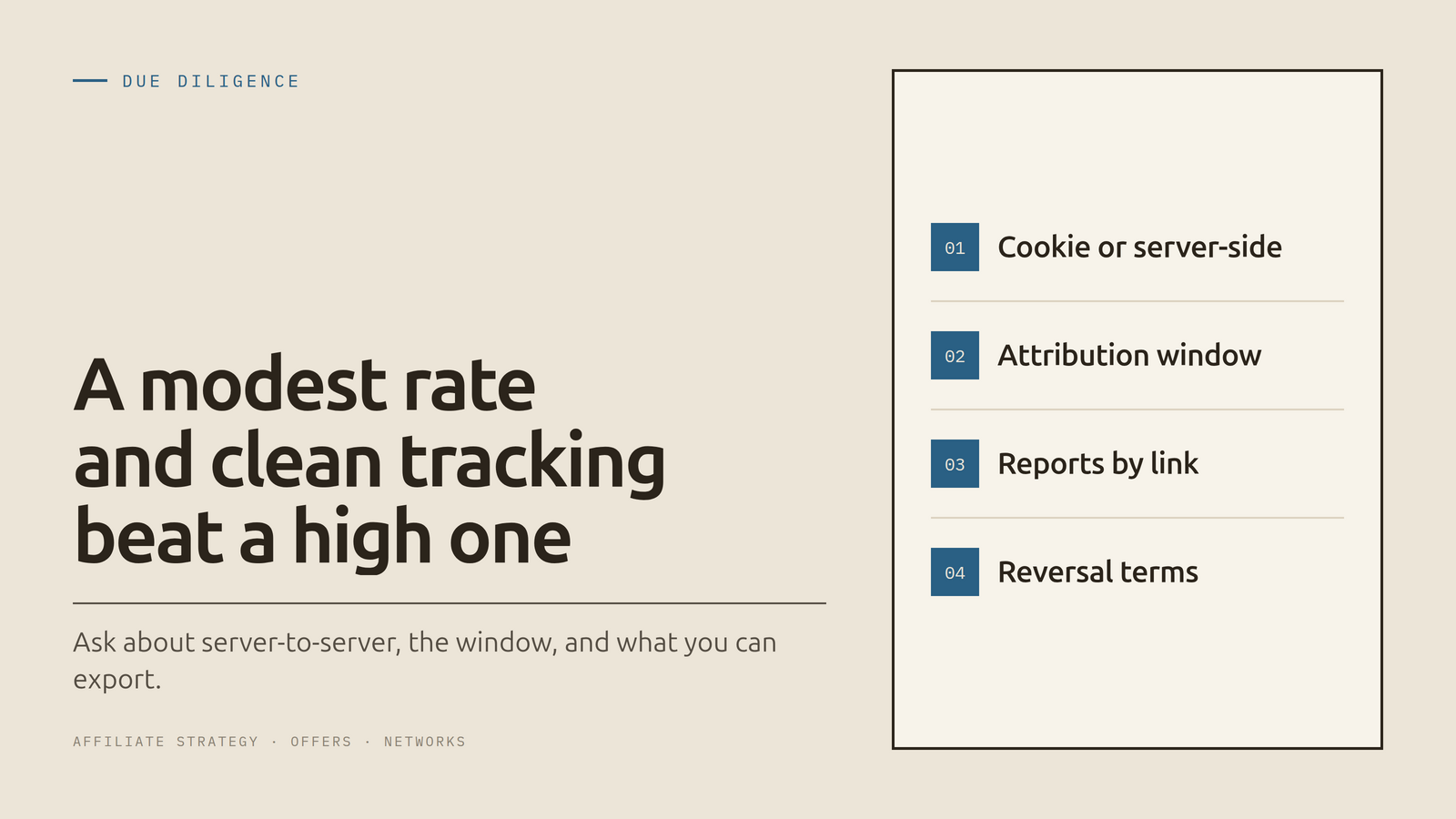
Ask whether tracking is cookie-based, server-to-server, or both. Cookies are simple and fragile. Privacy settings, a device switch, a checkout inside an app, or a cleared browser can all break the chain between the click and the order. Server-to-server tracking is stronger on paper because the merchant sends the conversion to the network directly. It is only stronger if the merchant implemented it properly, and integrations fail in quiet ways: a missing order status, a postback fired before payment clears, a field renamed in a site update.
| Mechanism | Where the record starts | What interrupts it | What to ask |
|---|---|---|---|
| Browser cookie | The click ID in the buyer's browser, read at checkout | Privacy settings, cleared storage, a different device, an in-app checkout | Which duration, and is it first-party on the merchant's domain? |
| Server-to-server postback | The merchant's order system, after checkout | A broken integration, a delayed status, a changed field | Which fields does it carry, and can you see the raw log? |
| Promo code | The code applied at checkout, matched back to you | A buyer who forgets it, or code stacking rules | Does a code override cookie credit, or add to it? |
| Manual reconciliation | A person matching orders to traffic afterwards | Volume, and whoever does the matching | How often does it run, and which export feeds it? |
Then ask the question most programmes never volunteer: what happens to a sale that was never tracked. Some networks accept a claim with the order reference and a delivery confirmation; some treat untracked traffic as their own and pay nothing. You will find out which on your first good month, so ask before you send traffic.
What the attribution window actually rewards
A thirty-day attribution window sounds generous until you learn that only the last click counts. If your article starts the purchase and a coupon site closes it, a last-click model pays the coupon site. Your content did the work and the credit went to the last touchpoint in the chain. Know the model before you plan content around a long consideration cycle.
Some programmes split credit across touchpoints, so the first click keeps part of the commission and the closing click keeps the rest. Others count the last click only but restart the window on every new click, which extends the merchant's claim on a returning buyer. Neither arrangement is wrong. Both change which kind of content makes money.
The short version: review and comparison content sits early in a decision and needs a model that pays for an early touch. Deal and coupon content sits at checkout and is built for last click. Ask four things. How long is the window, does a second click restart it, does a view count as a touch, and is credit allocated to one source or split. The mechanics are set out in attribution basics, and they matter more than the headline rate.
What you can export decides what you can optimise
Can you see clicks, conversions, and revenue by link, and by sub-identifier? Can you export that data as a file, on demand? If a network only shows monthly totals, you cannot tell which page earns and which one wastes effort, and every optimisation decision becomes a guess.
Sub-identifiers, sometimes called tracking parameters or sub-IDs, let you tag a link per placement. One for a review page, one for a newsletter, one for a comparison table, all pointing at the same offer. When your report lines up with theirs on the same key, reconciliation takes minutes instead of an afternoon. Ask whether the sub-ID survives the whole chain. A parameter accepted at the click and dropped at the postback is worse than none: it looks like data.
Request a sample export before you sign: one file, real column names, a date range. Check granularity (days or only months), latency (how long yesterday takes to appear), and retention (how far back it goes). A rolling window is fine, as long as you know where it ends and pull your own copy first.
Reversal terms outlive the commission you counted
Returns reduce your commission long after you counted it. A sale sitting in your dashboard as approved can still be reversed when the buyer sends the product back, cancels a subscription, or fails a fraud review. Read the reversal terms before you set a budget, and read them for four things.
The hold period, which is how long a conversion stays provisional. What triggers a reversal, and whether it removes the full order value or just your share. Whether a reversal can push your balance negative. And what happens if it does: does the network invoice you, hold future commissions against it, or write it off. A programme that can pull your balance below zero is a credit arrangement, not a payout arrangement.
Keep your own ledger of orders, dates, amounts, and status changes, and spend nothing until the hold expires. If the network's report and your ledger disagree by one order, you want to know which one is missing before the month closes. Automating affiliate reports is worth the setup once you are on more than one programme, so reconciliation runs whether or not you remember to.
The questions that vet an affiliate programme before you sign
Send these in one message, in writing. A programme that will not answer them is itself the answer.
- Is tracking cookie-based, server-to-server, or both, and which is the default?
- How long is the attribution window, and does a new click restart it?
- Is credit single-source or split across touchpoints?
- Do sub-IDs pass through to the conversion record?
- What does an export contain, and how far back does it go?
- How long is the hold period before a commission becomes final?
- What triggers a reversal, and can one push the balance negative?
- What is the process for a sale that was never tracked?
Add two follow-ups for any programme you plan to build a page around: who owns the customer relationship for retargeting, and whether the programme changes terms with notice. The first decides whether you can advertise to the buyer later, the second how much warning you get when the rate moves. read platform policy changes covers watching for those notices.
What to test in the first week
Answers on paper and behaviour in production are different things. In the first week, run the tracking yourself, before you have traffic worth losing.
- Click your own link from a clean browser, with a sub-ID you will recognise in a report.
- Confirm the click appears in the network's report, not only in your analytics.
- Complete a small purchase, or ask the merchant to place a test order.
- Check the conversion arrives with the right sub-ID, order value, and currency.
- Export the report and reconcile it against your own record by hand.
- Write down the status vocabulary: pending, approved, paid, reversed.
- Note the latency between the order and the conversion appearing.
If the sub-ID is missing from the conversion, stop and ask why. That is a tracking failure you found for the price of one order, and it will not improve at volume. If the conversion arrives with no order value, ask for the field mapping, because a commission you cannot check against the order is a number you take on faith.
Then read the clause that decides whether the rate matters at all: what the programme does about a sale its tracking missed. A rate is a promise about sales that get counted. A programme with clean tracking and a documented claims process pays out at a lower headline rate than one that never records your traffic, because the comparison is not rate against rate. It is rate multiplied by the share of your sales it pays on, and that factor is decided by this clause.
Next week, pick the programme you were closest to signing, send the eight questions in one message, and hold sign-up until the answers come back in writing. Then place the single test purchase before you write anything. A silent tracking failure gets more expensive every day.
FAQ
Is server-to-server tracking always better than cookies?
Not always, but it fails differently. A postback takes the buyer's browser out of the chain, so privacy settings and device switches stop mattering, which is where cookie tracking usually breaks. The trade is that you depend on the merchant's integration being correct, and a broken postback can fail silently for weeks. If both are offered, ask which is the default and check the fields in the conversion record.
Should I choose the higher rate or the better tracking?
Better tracking, unless the rate gap is large enough to survive the difference in recorded sales. A high rate only pays on the sales the programme counts, so a programme that misses a share of them can pay less in total than a lower rate with a clean record. The clause that settles it covers untracked sales: whether you can claim them with the order reference or lose them. Read it, run the first-week test, then compare the offers on what each actually paid.
How long should I wait before trusting a commission?
Until the hold period expires and the commission moves from provisional to final, and sometimes longer if the programme allows reversals after that. Do not treat an approved status as settled money. Keep a ledger of the orders behind each commission so a later reversal can be traced to a sale, and check the report at the end of the hold rather than the end of the month. If the programme cannot tell you when a commission becomes final, ask before you scale.
Some links on this site are affiliate links. The disclosure page explains how that works.