DeepSeek's demo reel: a palace, a racer and a Portal remake
Model launch pages have a house style. A few benchmark rows, a wall of model names, a diagram of a training pipeline, and a link to the weights. DeepSeek's page for V4.1-Flash-1017 does something else: it opens with a 3D model of a palace and asks you to be impressed by the picture before it shows you the table.
The four demos are the interesting part of the release, not because they prove the model is good but because they show what the lab thinks a model is for. Here is what is on the page, what it would take to reproduce, and the one thing on it with a clock attached.
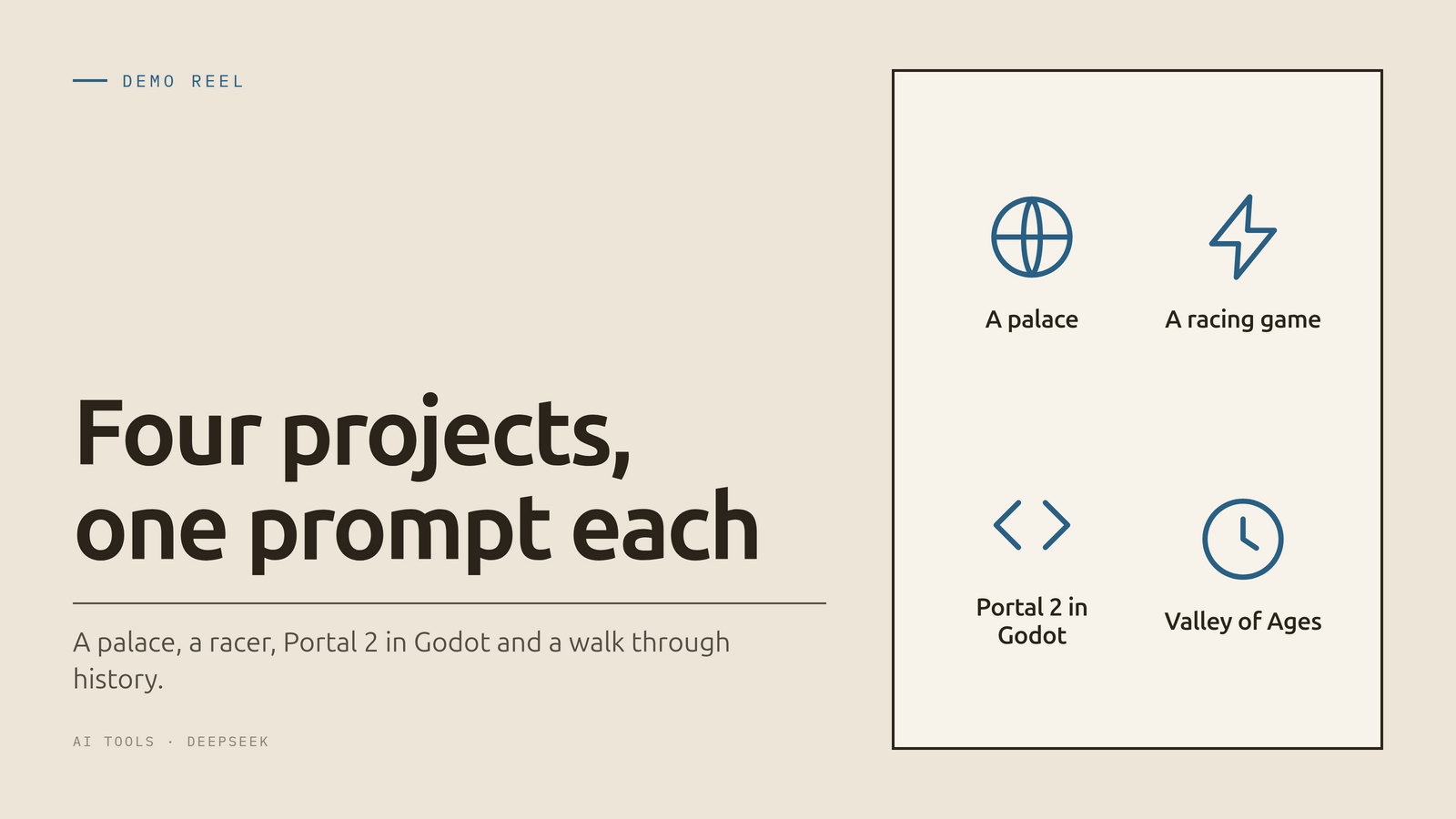
What the four demos actually are
A 3D model of the Forbidden City. No screenshot of a wireframe with a tooltip, and no mention of the libraries involved. If it is a real asset rather than a film, that is a mesh of the largest palace complex in the world generated from a prompt, which is a different kind of task from writing a function.
A web-based racing game. This one is the most legible to anyone who has shipped software. A browser game needs state, input handling, collision, a render loop and enough of a menu system that a person can start it. It is the demo closest to a real brief.
A Portal 2 recreation built in the Godot engine. Portal is Valve's first-person puzzle game, and Godot is an open-source engine with its own scene format and scripting language. So the model had to work inside a file format it has seen plenty of examples of, and it had to reason about a game whose mechanics are a physics gun and a pair of linked doors.
Valley of Ages. A 3D scene that walks through prehistory to the present. The description is a mood more than a spec, which is either the most ambitious item on the list or the vaguest, depending on whether anyone can open it.
"Wish-driven programming", and what the mechanism actually is
The headline phrase is Wish-Driven Programming Made Real, which is the kind of slogan that means "you describe it, we build it" and quietly skips the part where you spend a day fixing what came back.
The mechanism named underneath it is reinforcement learning with self-feedback, used to improve end-to-end project development. Translated: the model attempts a whole project, something evaluates the attempt, and the model is trained on the result. That is a real and increasingly common recipe for coding models, and it explains the demo choice. If you train on whole projects, then a whole game is the thing you are training for, not a function with a docstring.
What it does not explain is the gap between a demo and your repository. A greenfield racing game has no legacy code, no failing test suite inherited from three years of migrations, no product manager, and no dependency that only builds on one version of Node. Every demo on the page is a greenfield project, which is exactly the situation where generated code looks best.
The demo with a clock on it
Buried under the games is the item that changes an invoice. DeepSeek opened its search and fetch endpoints to everyone, powered by the in-house engine it claims serves hundreds of millions of requests a day. The announcement priced each endpoint at $0.75 per 1,000 calls, and made calls through server-side tools in DeepSeek Harness, Claude Code and Codex free until billing started on 31 October 2026 at 16:00 UTC.
That date has passed. If you wired an agent to those endpoints during the free window, the meter is now running, and the shape of the charge is per call rather than per token, so a loop that retries a failed fetch is a loop that bills. Prices checked against the release page on 4 November 2026, with no renewal or promotion date published for the free tier; check the page before you budget on it.
The endpoint itself is the quiet, useful part of the release. A coding agent that can search and fetch has a much shorter path to a working answer than one that cannot, and paying per call for that is easy to reason about. Three dollars buys four thousand fetches.
What a weekend with it would actually look like
If you want to test the claims rather than read them, the demos suggest the test. Pick something self-contained with a visual result, because that is the shape of task this release is aimed at: a small Godot scene, a browser toy with keyboard input, a chart that reads a CSV. Give it a brief you would give a contractor, then count the number of times you have to intervene.
The independent read is worth keeping in view while you do. Artificial Analysis placed the model on an Intelligence Index of 45 and called it fast and reasonably priced, then noted that it produced 210 million tokens across its evaluation tasks against a median of 140 million. Fast, cheap and chatty, which for a coding agent means it will keep talking when it should stop and start. If your harness has a token budget, the verbosity matters more than the speed.
Then compare against whatever you already use on the same brief. That comparison is the only one that means anything, because the four demos on the page were chosen after the model was trained, which is the definition of a demo.
Why the palace is first
One thing about the order. A palace is an odd first demo for a coding model, and it is not accidental that the most recognisable building in China comes before a racing game. It reads as a statement about what the model is for and whose capability it is.
That framing is worth noticing and then setting aside. There is a longer piece on this site about reading the launch page as a national showcase, including the part of the table that argues against the headline. For the serving layer underneath, DeepInfer is the open engine and it comes with three services you have to build. And if what you actually want is a model to point at bulk work, pick it by task rather than by leaderboard.
FAQ
Can I run these demos myself?
Only by rebuilding them. The page shows the results and links the weights, but it does not publish the prompts, the harness settings or the projects themselves, so the four demos are a demonstration rather than a reproducible test. The useful substitute is a brief of your own: something self-contained with a visible result, run once through this model and once through whatever you use now.
Is the free search and fetch access still available?
No. Server-side tool calls through DeepSeek Harness, Claude Code and Codex were free for API users until billing started on 31 October 2026 at 16:00 UTC. Since then each search and fetch endpoint bills at $0.75 per 1,000 calls. If an agent of yours still calls those endpoints in a retry loop, that loop is now a line item.
What does "wish-driven programming" mean in practice?
Less than the slogan implies. The mechanism named on the page is reinforcement learning with self-feedback on whole projects, so the model is trained to attempt a complete build and improve on the attempt. That makes it good at greenfield work with a clear result and says nothing about a repository with history, a failing test suite and a dependency nobody dares upgrade.
Some links on this site earn a commission. How that works.