Broad match in paid search is a discovery tool, not a permanent strategy. Its job is to show you what people actually type when they are close to buying, including the phrasings no keyword research tool gave you. Everything else about it, the wider reach, the cheaper clicks, the "learning" the platform promises, is a side effect of that one useful function. Treat a broad match campaign as a research budget with a conversion pixel attached, and it stays useful. Treat it as a campaign you leave running, and it becomes a permanent line item that pays for searches your exact campaigns already own.
Broad match is a discovery tool, not a home
Here is the mechanism, because it explains both the value and the waste. Broad match does not match the words you typed. It matches against the platform's reading of intent, which pulls in synonyms, related problems, other phrasings of the same question, and, when the signal is weak, queries that share a theme and nothing else. You are buying coverage of a topic rather than a phrase.
That is exactly what you want at the start. Affiliate queries, comparison searches, problem-based searches, the ones where someone describes a symptom and has not learned the product category yet, all arrive under the same broad theme. A keyword tool cannot give you those, because it works from volume data on phrases that already exist. Broad match gives you the phrase itself, in the search query report, with a cost attached.
The waste is built into the same mechanism. While the platform is still working out what the theme means, you pay for the misses. That is not a fault in your setup and no amount of negative keyword maintenance removes it entirely. The point of the first two to four weeks is to convert that spend into a query list, so budget it as research rather than judging it as a campaign.
Read the search query report before you read the spend
Most people open a broad match campaign and look at cost per conversion. That number is close to meaningless in the discovery phase, because the useful information is concentrated in a handful of queries and the rest is the price of finding them. Open the search query report first, and sort it twice: once by cost, once by conversions.
Then put every query into one of three buckets:
- Queries that converted. These are the deliverable.
- Queries that spent money on clearly relevant intent without converting. These are candidates for a tighter keyword or a changed landing page.
- Queries with no connection to what you sell. These become negatives.
The negative keyword work is a control valve, not a purge. Add a shared negative list for the categories you never want to appear in, keep it fed from the third bucket, and re-check it when the spend pattern shifts. A broad campaign with no negatives is not a discovery campaign, it is a donation.
What you are looking for in the first bucket is a surprise: a phrase with real conversions that you would never have guessed. Those are the ones that justify the exercise. Write them down as you go, with the conversion data and the date, because the transition below is built entirely from that list.
The signal that says you have extracted the learning
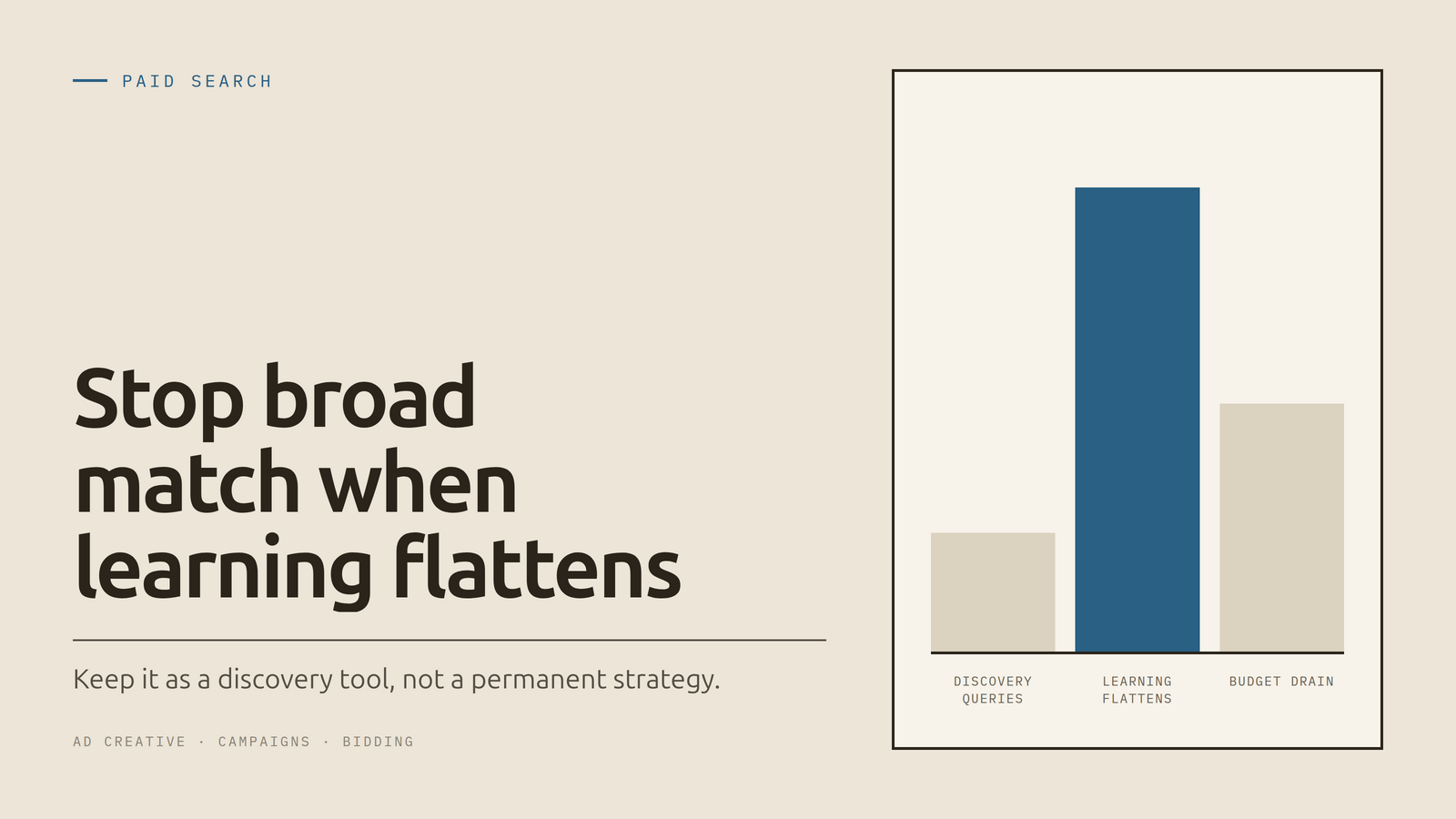
Two readings tell you the discovery phase is over, and they usually arrive together. The first is that the conversion rate on broad match stops improving. The second is that cost per conversion starts to climb while spend holds steady. When both are true week over week, the campaign is no longer buying you new information, it is buying you the same mix of queries at a worse price.
Watch the conversion rate as a trend rather than a single week, because a slow week looks identical to a flattening one. If the platform is still finding converters you have not seen before, the discovery is still working even if the week was small. If the list of new converting queries has stopped growing while spend has not, the learning has been extracted whether or not the conversion rate looks stable.
If you keep running broad match past that point, you are paying for low-intent searches that were never going to convert, and you are paying more for them each week as the cheap relevant inventory gets consumed by your own competitors and by the exact campaigns you should have built. The flat learning curve is the signal to stop treating broad as your main campaign.
Build phrase and exact from what converted
Take the converting queries out of the report and build the tight campaigns from them. Exact match for the phrases that converted on their own, phrase match for the families where the word order mattered but the modifier did not. Give each of those campaigns its own budget, so that the comparison with broad match is honest and you can see what the tighter keywords do at a stable spend.
Do not switch broad off on the same afternoon. Run the two side by side for a short overlap, and add the new exact keywords as negatives in the broad campaign so it stops paying for the traffic the exact campaign now owns. Without that step the broad campaign keeps bidding on its own best queries, the exact campaign looks worse than it is, and you draw the wrong conclusion about which one works.
This is the same discipline as any other single-variable test, and testing one ad variable at a time covers the reasoning. Change the match type and the budget at once and you cannot tell which one moved cost per conversion.
The exception, and the quarterly re-test
Some high-value keywords with low volume can stay on broad match indefinitely if the cost per conversion remains acceptable. Narrow, expensive categories behave this way: the audience is small, the exact match version starves, and broad is the only setting that finds enough of the right people to keep the campaign alive. The test is not whether it is broad match, it is whether the cost per conversion stays where you can afford it.
Revisit the mix every quarter. Market moves and competitor bidding shift what the optimal mix is, and a theme that was too noisy three months ago can be worth running again once the auction around it changes. Keep the query lists from each round, because the second attempt usually starts from a better negative list and reaches the useful queries faster.
| Phase | What you are buying | What to read | Exit condition |
|---|---|---|---|
| Discovery, first two to four weeks | Coverage of a theme | Search query report, bucketed by intent | A stable list of converting queries |
| Extraction | Confirmation that the list is complete | New converting queries per week, cost per conversion | Conversion rate flat, cost per conversion rising |
| Transition | Both match types, overlapping | Exact campaign at its own budget, negatives on broad | Exact holds cost per conversion on its own |
| Maintenance | Nothing new | Quarterly review of the mix | Either a new theme to explore or nothing |
| Exception | Reach in a thin category | Cost per conversion only | Cost per conversion leaves your tolerance |
One more reading belongs in the review: the conversion data itself. If your attribution window is short or your tracking fires twice, the cost per conversion you are using to make these calls is wrong in a way that flatters broad match, because broad match is where most of the unmatched conversions land. Affiliate attribution basics is the background, and it is worth checking before you conclude that a noisy campaign is profitable.
FAQ
How long should broad match run before I judge it?
Two to four weeks is the working window, and the judgement should come from the search query report rather than the campaign's cost per conversion. In that window you want to see the list of converting queries settle, with fewer genuinely new phrases turning up each week. If the platform is still surfacing converters you have not seen, give it longer. If the list has stopped growing, the discovery is finished and the campaign is now just spending.
Should I pause broad match the day I launch exact?
No. Run both for a short overlap with the new exact keywords added as negatives on the broad campaign. Pausing broad immediately loses the coverage you have not yet replaced, and running it without negatives means the two campaigns bid against each other for the same queries. The overlap is also the only clean way to see whether the exact campaign can hold cost per conversion at a comparable spend, which is the question you actually need answered.
Is a rising cost per conversion always the signal to stop?
Not on its own. A rise in one week can come from a competitor entering the auction, a seasonal shift in who is searching, or a change in your own landing page. Look for the rise alongside a flattening conversion rate and a shrinking list of new converting queries, since those three together describe a campaign that has run out of information. A rise in cost per conversion with new converting queries still appearing is a different situation and usually worth paying for a bit longer.
Next week, open the search query report for any broad match campaign you are running and bucket the queries into converted, relevant but unconverted, and irrelevant. If the converted bucket has stopped growing, write the exact and phrase campaigns this month and put the negatives in place.
Some links on this site are affiliate links. The disclosure page explains how that works.